
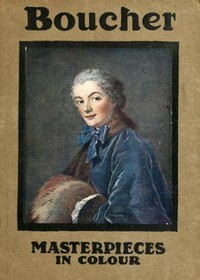
Boucher
Written by Haldane Macfall
Chaptra reads alongside you — AI insights, chapter breakdowns and reader discussions for every book. Join free
About this book
Reading guide
Themes, characters and key ideas in Boucher, written by Chaptra AI.
- about 8 hours
- advanced
- Historical
- Artistic
- Biographical
Haldane Macfall's "Boucher" offers an illuminating early 20th-century biographical exploration of François Boucher, a pivotal figure in 18th-century French art. The book meticulously chronicles Boucher's journey from his humble Parisian origins to his esteemed position as a court painter to Louis XV, particularly under the patronage of figures like the Marquise de Pompadour. It delves into his artistic development, the influences that shaped his distinctive Rococo style, and the challenges he faced amidst evolving aesthetic tastes. Beyond his artistic triumphs, Macfall also paints a portrait of Boucher's personal life and his deep integration into the cultural and political landscape of his era, presenting him as both a master painter and a product of his vibrant century.
“As an early 20th-century biography, specific memorable quotes are difficult to extract without direct access to the text. However, one might expect passages that eloquently describe Boucher's artistic technique, the opulence of the Rococo era, or the influence of his patrons, such as 'Boucher's brush, ever nimble and seductive, captured the ephemeral grace of a world poised on the brink of revolution,' or 'The Marquise de Pompadour, a connoisseur of beauty and power, found in Boucher the perfect interpreter of her refined aesthetic and the spirit of the age.'”
Key themes
- Patronage and Power in 18th-Century Art
- This theme is central to understanding Boucher's career, as it highlights the critical role of aristocratic and royal patronage in shaping artistic production during the Ancien Régime. The book illustrates how artists like Boucher were dependent on powerful figures for commissions, financial support, and social advancement, and how these relationships influenced the subject matter, scale, and style of their work.
- The Nature of Artistic Genius and Creativity
- The book explores how Boucher's innate talent was nurtured through training and experience, leading to his unique mastery of the Rococo style. It delves into the creative process, the influences that shaped his vision, and his ability to innovate within the prevailing aesthetic demands of his era. This theme examines what constitutes artistic brilliance and how it manifests in an individual's life and work.
- The Rococo Style: Its Zenith and Critique
- The biography meticulously explores the characteristics of the Rococo style, with Boucher presented as its quintessential master. It details the style's emphasis on lightness, gaiety, decorative flourish, sensuality, and mythological or pastoral themes. Simultaneously, the book touches upon the eventual critique of Rococo as superficial or decadent, foreshadowing the rise of Neoclassicism and changing aesthetic values.
Worth discussing
How does Macfall's biography illuminate the relationship between artistic creation and aristocratic patronage in 18th-century France?
Chapter-by-chapter breakdowns, character arcs and the full thematic analysis come with a free account.
Discussions
No one has started one yet
Questions this book opens up
No discussions yet
Be the first to start a discussion about this book!
Sign up to start the discussionReviews
No reviews yet
Be the first to review this book!