
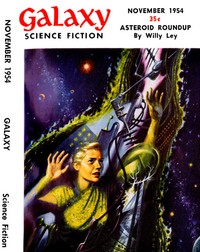
Big Ancestor
Written by F. L. (Floyd L.) Wallace
Chaptra reads alongside you — AI insights, chapter breakdowns and reader discussions for every book. Join free
About this book
Reading guide
Themes, characters and key ideas in Big Ancestor, written by Chaptra AI.
- about 8 hours
- intermediate
- mysterious
- philosophical
- exploratory
F. L. Wallace's "Big Ancestor" is an early 1950s science fiction novel chronicling humanity's ambitious quest for its origins amidst the stars. The narrative follows Sam Halden and his expedition team, including an alien pilot, Taphetta, as they journey through the Milky Way, grappling with complex themes of evolution, interspecies relationships, and racial identity. Their search for an ancient, forgotten civilization leads them to a deserted planet, revealing a devastating plague that caused its inhabitants' demise, ironically stemming from vermin they themselves transported. This profound discovery forces the crew to confront the unsettling truth about their own history, challenging their perceptions of progress and human superiority.
“We chase the ghost of our beginning, only to find it's a reflection of our potential end.”
Key themes
- The Quest for Origins & Human Identity
- The central driving force of the narrative, this theme explores humanity's innate desire to understand its beginnings and, in doing so, define its present and future. The journey through the Milky Way is a literal and metaphorical search for ancestral roots, forcing characters to confront what truly constitutes 'humanity' beyond mere genetics or current evolutionary stage.
- Evolution, Speciation, and Interbreeding
- Wallace delves into the dynamic nature of life, portraying humanity not as a static entity but as part of a continuous evolutionary process. The presence of 'humans of different evolutionary stages' and the discussion of 'human interbreeding' and the 'biological spectrum of the species' challenge rigid classifications, suggesting a fluid and interconnected web of life where species boundaries are less absolute.
- The Hubris of Civilization and Unintended Consequences
- This theme explores the dangers of unchecked progress and the illusion of control, particularly evident in the fate of the advanced civilization. The ironic twist—that their downfall was caused by a plague mutated from vermin they unwittingly carried—serves as a powerful cautionary tale against arrogance and the unforeseen repercussions of technological advancement and expansion.
Worth discussing
How does 'Big Ancestor' challenge or reinforce traditional notions of human identity and racial purity?
Chapter-by-chapter breakdowns, character arcs and the full thematic analysis come with a free account.
Discussions
No one has started one yet
Questions this book opens up
No discussions yet
Be the first to start a discussion about this book!
Sign up to start the discussionReviews
No reviews yet
Be the first to review this book!