
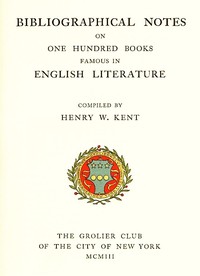
Bibliographic Notes on One Hundred Books Famous in English Literature
Written by Henry Watson Kent
Chaptra reads alongside you — AI insights, chapter breakdowns and reader discussions for every book. Join free
About this book
Read it with a club
Small groups reading the same books and talking as they go.


News
- 4 members
- 1,813 discussions
- Active Sep 11
Read Bibliographic Notes on One Hundred Books Famous in English Literature alongside people who are reading it too.
Also here: News Bulletin, Just Joking....
Chaptra Prime — paid clubs, every club feature, and unlimited reading support, for $5 a month or $60 once.
See PrimeReading guide
Themes, characters and key ideas in Bibliographic Notes on One Hundred Books Famous in English Literature, written by Chaptra AI.
- about 8 hours
- advanced
- informative
- scholarly
- meticulous
Henry W. Kent's "Bibliographic Notes on One Hundred Books Famous in English Literature" is a seminal reference work from the early 20th century, meticulously documenting the historical and physical attributes of significant English literary works. The book serves as a detailed guide, providing essential bibliographic facts, publication histories, and unique features for each selected title. By presenting these celebrated books alongside their title pages, Kent illustrates the evolutionary trajectory of English literature, emphasizing both its aesthetic merit and its historical context. This work profoundly highlights the intricate relationship between authorship, publishing, and the material craft of bookmaking, offering invaluable insights into literary heritage.
“This work serves as a reference guide, compiling essential bibliographical facts about significant books in English literature, notably focusing on their historical importance, editions, and unique features.”
Key themes
- The Materiality of the Book
- This theme explores the idea that the physical form of a book – its printing, paper, binding, and specific editions – is not merely a vessel for text but an integral part of its historical, cultural, and literary significance. Kent meticulously details these physical attributes, arguing that understanding the book as an artifact is crucial for a complete appreciation of its content and legacy.
- Literary Canon Formation
- Kent's selection of 'One Hundred Books Famous in English Literature' implicitly and explicitly addresses the process by which certain works become recognized as canonical, defining the scope and character of a national literature. The book explores the factors contributing to a work's 'fame' and historical importance, which often extend beyond purely aesthetic judgment to include cultural impact, influence, and endurance.
- The Value of Bibliography and Scholarship
- Kent's work itself is a testament to the indispensable role of bibliography in literary studies and historical preservation. The theme highlights that meticulous documentation, critical analysis of physical artifacts, and the compilation of detailed scholarly notes are fundamental to understanding, authenticating, and preserving cultural heritage. It underscores the academic discipline dedicated to the study of books.
Worth discussing
What criteria do you think Kent used to select his 'One Hundred Books Famous in English Literature,' and how might a similar list compiled today differ?
Chapter-by-chapter breakdowns, character arcs and the full thematic analysis come with a free account.
Discussions
No one has started one yet
Questions this book opens up
No discussions yet
Be the first to start a discussion about this book!
Sign up to start the discussionReviews
No reviews yet
Be the first to review this book!