
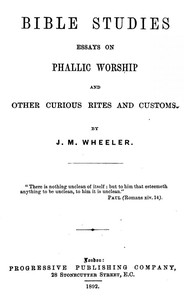
Bible Studies: Essays on Phallic Worship and Other Curious Rites and Customs
Written by J. M. (Joseph Mazzini) Wheeler
Chaptra reads alongside you — AI insights, chapter breakdowns and reader discussions for every book. Join free
About this book
Reading guide
Themes, characters and key ideas in Bible Studies: Essays on Phallic Worship and Other Curious Rites and Customs, written by Chaptra AI.
- about 10 hours
- advanced
- analytical
- challenging
- historical
J. M. Wheeler's "Bible Studies: Essays on Phallic Worship and Other Curious Rites and Customs" is a late 19th-century collection that provocatively re-examines biblical narratives through an anthropological and historical lens. The book posits that many ancient religious practices, including phallic worship, are deeply embedded in the historical and cultural contexts of the Bible, often overlooked or sanitized by contemporary interpretations. Wheeler critiques conventional readings, advocating for a deeper understanding of the evolution of religious beliefs and ritual practices among ancient Jews and their neighbors. By tracing the manifestations of primitive rites, the essays aim to reveal surprising underlying elements within familiar scriptures. It challenges readers to reconsider the origins and implications of religious traditions through a scholarly, albeit controversial, inquiry.
“"To truly understand the sacred texts, one must first confront the profane origins from which they sprang."”
Key themes
- Anthropological Interpretation of Biblical Texts
- This is the core methodological theme, advocating for the study of the Bible not solely as divine revelation but as a historical and cultural document, shaped by human societies and their evolving practices. Wheeler insists that understanding ancient social structures, customs, and beliefs is crucial for deciphering biblical narratives.
- Phallic Worship and Fertility Rites
- A central substantive theme, positing that phallic worship and related fertility rites were widespread in ancient civilizations and significantly influenced, or are subtly present within, biblical narratives and Jewish religious practices. Wheeler explores the symbolic importance of these rites in understanding creation, life, and the divine.
- Evolution of Religious Beliefs and Rituals
- This theme explores the idea that religious practices and beliefs are not static but evolve over time, adapting to cultural changes and societal needs. Wheeler traces a progression from more 'primitive' or 'curious' rites to the more formalized and often 'sanitized' practices found in later religious traditions, including Judaism.
Worth discussing
How does an anthropological approach to religious texts alter one's understanding of their meaning and significance?
Chapter-by-chapter breakdowns, character arcs and the full thematic analysis come with a free account.
Discussions
No one has started one yet
Questions this book opens up
No discussions yet
Be the first to start a discussion about this book!
Sign up to start the discussionReviews
No reviews yet
Be the first to review this book!