
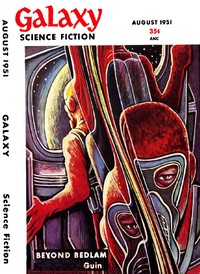
Beyond Bedlam
Written by Wyman Guin
Chaptra reads alongside you — AI insights, chapter breakdowns and reader discussions for every book. Join free
About this book
Reading guide
Themes, characters and key ideas in Beyond Bedlam, written by Chaptra AI.
- about 8 hours
- intermediate
- Dystopian
- Psychological
- Thought-provoking
Wyman Guin's "Beyond Bedlam" plunges readers into a future where individuals navigate complex societal structures built around mandatory drug use and the management of multiple personalities, or 'egos.' The narrative centers on Mary Walden, a young girl grappling with her own shifting identities, particularly her contentious relationship with a secondary ego named Susan, within a family context marked by feelings of inadequacy. The novel explores a society that has radically redefined mental illness, treating conditions like schizophrenia with advanced pharmaceuticals and mandatory 'ego-shift' classes, a stark contrast to ancient perceptions. Through Mary's experiences and her school assignment on historical mental illness, the story delves into the profound psychological and social implications of living in a world where human nature is meticulously controlled to prevent internal and external conflict.
“"In our world, the ancient madness of 'schizophrenia' is merely a facet of the self we have learned to manage, not a curse to be feared."”
Key themes
- Identity and the Fragmented Self
- This is the central theme, exploring what constitutes an individual's identity when it is composed of multiple, distinct 'egos' and managed by external forces (drugs). The novel questions the authenticity of a self that is chemically maintained and constantly shifting, challenging traditional notions of a singular, coherent identity.
- Societal Control and Conformity
- The novel depicts a society that has achieved order and peace by exerting extreme control over human nature, specifically through mandatory drug use and psychological conditioning. It raises questions about the cost of such control, particularly the suppression of individuality and potential for genuine conflict or self-discovery, in the name of collective stability.
- Mental Health and Its Perception
- The story directly contrasts ancient perceptions of mental illness, particularly schizophrenia, with a future society that has 'solved' the problem through medication and ego management. This theme explores how society defines and treats psychological conditions, and whether the future's solution truly represents a cure or merely a different form of management and suppression.
Worth discussing
How does the novel's depiction of 'egos' and mandatory drug use challenge our understanding of personal identity and free will?
Chapter-by-chapter breakdowns, character arcs and the full thematic analysis come with a free account.
Discussions
No one has started one yet
Questions this book opens up
No discussions yet
Be the first to start a discussion about this book!
Sign up to start the discussionReviews
No reviews yet
Be the first to review this book!