
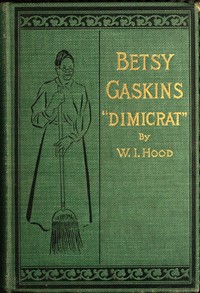
Betsy Gaskins (Dimicrat), Wife of Jobe Gaskins (Republican): Or, Uncle Tom's Cabin Up to Date
Written by W. I. (William I.) Hood
Chaptra reads alongside you — AI insights, chapter breakdowns and reader discussions for every book. Join free
About this book
Reading guide
Themes, characters and key ideas in Betsy Gaskins (Dimicrat), Wife of Jobe Gaskins (Republican): Or, Uncle Tom's Cabin Up to Date, written by Chaptra AI.
- about 8 hours
- intermediate
- humorous
- satirical
- observational
W. I. Hood's "Betsy Gaskins (Dimicrat), Wife of Jobe Gaskins (Republican): Or, Uncle Tom's Cabin Up to Date" is a late 19th-century novel that explores the socio-political landscape through the eyes of Betsy Gaskins, a "Dimicrat" married to a "Republican." The narrative centers on Betsy and Jobe's financial struggles, particularly a looming mortgage held by their wealthy Congressman, Mr. Richer, which symbolizes broader economic disparities. Betsy's vibrant first-person voice offers humorous yet incisive critiques of contemporary politics, economic hardship, and the influence of wealth on society. Despite their differing political allegiances, the Gaskins' marriage is founded on mutual respect, providing a personal lens through which to examine the era's divisive issues. The book uses this domestic framework to deliver a pointed social and political satire, hinting at the need for an updated form of advocacy akin to "Uncle Tom's Cabin."
“"A body might be a Dimicrat or a Republican, but when the mortgage man comes callin', he don't ask for your party card, just your coin."”
Key themes
- Political Division and Satire
- The novel directly tackles the intense political divisions of the late 19th century, personified by the marriage of a "Dimicrat" and a "Republican." It uses satire to expose the absurdities, hypocrisies, and often superficial nature of partisan politics, while simultaneously suggesting that shared humanity and mutual respect can bridge ideological gaps.
- Economic Hardship and Class Struggle
- Central to the plot is the Gaskins' struggle with financial strain and a looming mortgage. This theme explores the vulnerability of ordinary citizens to economic pressures and the stark class divide between the wealthy elite (represented by Congressman Richer) and the working poor. It highlights the anxieties of the Gilded Age concerning wealth inequality and the security of one's home and livelihood.
- Social Commentary and Reform
- By explicitly titling itself "Uncle Tom's Cabin Up to Date," the novel positions itself as a direct piece of social commentary aiming for reform. It seeks to expose and critique contemporary injustices, drawing parallels to the moral outrage evoked by slavery, but applying it to new forms of economic and political subjugation prevalent in post-Reconstruction America. It calls for awareness and perhaps action against these modern 'chains.'
Worth discussing
How does Betsy and Jobe's marriage serve as a microcosm for the political divisions of their time, and what message does their mutual respect convey?
Chapter-by-chapter breakdowns, character arcs and the full thematic analysis come with a free account.
Discussions
No one has started one yet
Questions this book opens up
No discussions yet
Be the first to start a discussion about this book!
Sign up to start the discussionReviews
No reviews yet
Be the first to review this book!