
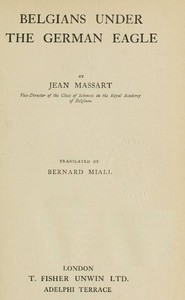
Belgians Under the German Eagle
Written by Jean Massart
Chaptra reads alongside you — AI insights, chapter breakdowns and reader discussions for every book. Join free
About this book
Reading guide
Themes, characters and key ideas in Belgians Under the German Eagle, written by Chaptra AI.
- about 8 hours
- intermediate
- Somber
- Resilient
- Historical
Jean Massart's "Belgians Under the German Eagle" is a poignant historical account documenting the harrowing experiences of Belgians during Germany's occupation in World War I. Published in the early 20th century, the book meticulously details the violation of Belgium's neutrality and the profound impact of German censorship and wartime oppression. Massart, committed to objectivity, uniquely leverages German sources to underscore the brutal realities faced by the Belgian populace. The narrative powerfully conveys the deep sorrow, resilience, and psychological toll endured by a nation grappling with destruction, brutality, and propaganda, setting a tone of lament and resistance.
“"It is with German documents that we shall relate the story of Belgium under German rule."”
Key themes
- Violation of Neutrality and International Law
- This is a foundational theme, as the book explicitly begins by outlining Germany's egregious breach of Belgium's internationally recognized neutrality. Massart highlights how this act set the stage for all subsequent suffering, framing the occupation as an unlawful and immoral act of aggression, directly contravening established international agreements.
- The Horrors and Impact of Occupation
- The book vividly details the daily realities of life under German occupation, encompassing physical destruction, economic hardship, systematic oppression, and brutality. It explores how war extends beyond the battlefield to devastate civilian life, erode freedoms, and inflict psychological trauma on an entire populace.
- Truth vs. Propaganda and Censorship
- Massart's methodology of using German sources is a direct engagement with this theme. The book implicitly and explicitly critiques wartime propaganda by presenting documented facts that contradict official narratives. It exposes how censorship is used as a tool of control, shaping public perception and suppressing dissent, while simultaneously demonstrating the power of objective truth to counter such manipulation.
Worth discussing
How does Massart's commitment to using German sources impact the credibility and emotional resonance of his account?
Chapter-by-chapter breakdowns, character arcs and the full thematic analysis come with a free account.
Discussions
No one has started one yet
Questions this book opens up
No discussions yet
Be the first to start a discussion about this book!
Sign up to start the discussionReviews
No reviews yet
Be the first to review this book!