
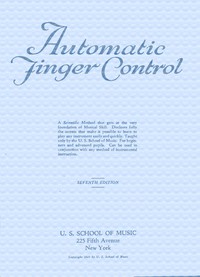
Automatic finger control: Seventh Edition
Written by U.S. School of Music
Chaptra reads alongside you — AI insights, chapter breakdowns and reader discussions for every book. Join free
About this book
Read it with a club
Small groups reading the same books and talking as they go.


News
- 4 members
- 1,813 discussions
- Active Sep 11
Read Automatic finger control: Seventh Edition alongside people who are reading it too.
Also here: News Bulletin, Just Joking....
Chaptra Prime — paid clubs, every club feature, and unlimited reading support, for $5 a month or $60 once.
See PrimeReading guide
Themes, characters and key ideas in Automatic finger control: Seventh Edition, written by Chaptra AI.
- about 3 hours
- intermediate
- instructive
- disciplined
- focused
"Automatic Finger Control: Seventh Edition" by the U.S. School of Music is an early 20th-century instructional manual dedicated to developing superior musical dexterity. It outlines a scientific method for training finger muscles to achieve independence, speed, and coordination with the brain. The book presents a systematic series of exercises, intended for consistent, twice-daily practice, to build muscle memory and enhance technique for musicians of all levels. Emphasizing concentration and progressive difficulty, it aims to facilitate rapid and efficient skill acquisition across various musical instruments. This guide serves as a foundational text for developing fundamental physical control essential for musical performance.
“"Automatic Finger Control... is a scientific publication... designed to enhance musical skill by training the muscles of the fingers to move independently and quickly in coordination with the brain."”
Key themes
- Discipline and Habitual Practice
- The book fundamentally champions the idea that musical skill is not merely innate talent but a product of rigorous discipline and consistent, habitual practice. It prescribes a strict regimen (twice daily) to build muscle memory and dexterity, underscoring the psychological commitment required for mastery.
- Scientific/Systematic Approach to Skill Acquisition
- The book frames finger control as a 'scientific' endeavor, implying a methodical, analytical approach to training the body for musical performance. It presents a 'systematic series of exercises' that progress in complexity, reflecting a belief that skill can be broken down, analyzed, and built up through structured instruction rather than solely through intuition or imitation.
- Mind-Body Coordination and Independence
- A core tenet is the training of fingers to move 'independently and quickly in coordination with the brain.' This highlights the intricate connection between mental intent and physical execution, and the challenge of achieving autonomous control over individual digits, essential for complex musical passages. It addresses the psychological aspect of focus and the physical aspect of motor control.
Worth discussing
How does the 'scientific' approach to finger training described in the book compare to modern understanding of motor skill acquisition in music?
Chapter-by-chapter breakdowns, character arcs and the full thematic analysis come with a free account.
Discussions
No one has started one yet
Questions this book opens up
No discussions yet
Be the first to start a discussion about this book!
Sign up to start the discussionReviews
No reviews yet
Be the first to review this book!