
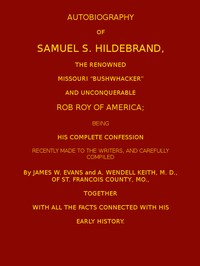
Autobiography of Samuel S. Hildebrand, the Renowned Missouri "Bushwacker" and Unconquerable Rob Roy of America: Being his Complete Confession
Written by Samuel S. Hildebrand
Chaptra reads alongside you — AI insights, chapter breakdowns and reader discussions for every book. Join free
About this book
Reading guide
Themes, characters and key ideas in Autobiography of Samuel S. Hildebrand, the Renowned Missouri "Bushwacker" and Unconquerable Rob Roy of America: Being his Complete Confession, written by Chaptra AI.
- about 9 hours
- intermediate
- dark
- vengeful
- historical
Samuel S. Hildebrand's autobiography offers a raw, first-person account of his transformation from a civilian farmer into a notorious Missouri 'bushwhacker' during the American Civil War. Driven by personal tragedy and perceived injustices from Union supporters, Hildebrand chronicles his descent into guerrilla warfare, positioning himself as a victim forced into a life of violent retribution. The narrative serves as a powerful, albeit biased, attempt to reclaim his story from sensationalized accounts, emphasizing themes of vengeance, loss, and the brutal realities faced by individuals caught in the crossfire of a deeply fractured society.
“"I have determined to write out a true account of my life, that the world may know the truth and judge for themselves, rather than rely on the many false and scandalous reports spread abroad concerning me."”
Key themes
- Vengeance and Retribution
- The central driving force of Hildebrand's narrative. His entire transformation and subsequent actions are framed as a direct response to personal losses and perceived injustices, illustrating the destructive and consuming nature of a life dedicated to retribution.
- The Moral Ambiguity and Brutality of War
- The book vividly portrays the blurring of lines between combatant and civilian, soldier and criminal, especially in the context of irregular warfare in a border state. It questions conventional notions of heroism and villainy, presenting a protagonist who is both victim and perpetrator, highlighting the dehumanizing effects of prolonged conflict.
- Self-Justification and Historical Narrative
- A primary purpose of Hildebrand's autobiography is to control his own narrative and counter the 'fictionalized accounts' that have demonized him. It's a powerful example of how individuals attempt to shape their legacy and justify their actions, highlighting the subjective nature of historical truth and the power of personal testimony.
Worth discussing
To what extent can Hildebrand's autobiography be considered a reliable historical document? What are its inherent biases?
Chapter-by-chapter breakdowns, character arcs and the full thematic analysis come with a free account.
Discussions
No one has started one yet
Questions this book opens up
No discussions yet
Be the first to start a discussion about this book!
Sign up to start the discussionReviews
No reviews yet
Be the first to review this book!