
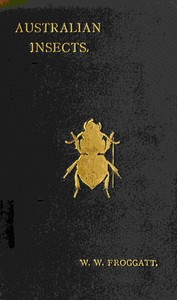
Australian insects
Written by Walter W. (Walter Wilson) Froggatt
Chaptra reads alongside you — AI insights, chapter breakdowns and reader discussions for every book. Join free
About this book
This work by Froggatt, Walter W. (Walter Wilson) offers readers a unique literary experience. The narrative explores themes of insects.
Reading guide
Themes, characters and key ideas in Australian insects, written by Chaptra AI.
- about 18 hours
- intermediate
- informative
- scientific
- observational
Walter W. Froggatt's "Australian Insects" is a foundational non-fiction work, serving as one of the earliest comprehensive surveys of Australia's rich and unique insect fauna. Published in 1907, it systematically documents various orders, families, and species, offering detailed descriptions, classifications, and observations derived from Froggatt's extensive fieldwork. The book was instrumental in bringing Australian entomology to a wider audience, both scientific and general, establishing a critical baseline for understanding the continent's invertebrate biodiversity at the turn of the 20th century. It stands as a testament to early natural history scholarship and a vital historical record of Australia's natural heritage.
“"The importance of insects in the economy of nature cannot be over-estimated."”
Key themes
- Biodiversity and Classification
- This is the central theme, as the book is fundamentally a systematic catalog and description of Australian insect species. Froggatt meticulously details the vast array of insect life, organizing it into orders, families, and genera, highlighting the incredible diversity and complexity of the natural world. This theme underscores the scientific endeavor to understand and categorize life forms.
- The Importance of Observation and Empirical Study
- Froggatt's work is a testament to the power of direct observation and empirical investigation in natural science. The book is built upon years of fieldwork, collection, and careful study, emphasizing the necessity of direct engagement with the natural world to gather accurate data. This theme reflects the scientific method prevalent in natural history during his era.
- Ecological Relationships and Economic Impact
- Beyond mere classification, Froggatt often delves into the ecological roles of insects, describing their interactions with plants, other animals, and their environment. He also frequently highlights the economic significance of various species, whether as agricultural pests, vectors of disease, or beneficial organisms (e.g., pollinators, decomposers), thereby connecting scientific understanding with human interests and practical applications.
Worth discussing
How has our understanding of insect classification and evolution changed since Froggatt's time?
Chapter-by-chapter breakdowns, character arcs and the full thematic analysis come with a free account.
Discussions
No one has started one yet
Questions this book opens up
No discussions yet
Be the first to start a discussion about this book!
Sign up to start the discussionReviews
No reviews yet
Be the first to review this book!