
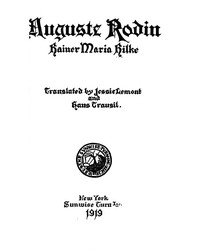
Auguste Rodin
Written by Rainer Maria Rilke
Chaptra reads alongside you — AI insights, chapter breakdowns and reader discussions for every book. Join free
About this book
Reading guide
Themes, characters and key ideas in Auguste Rodin, written by Chaptra AI.
- about 8 hours
- advanced
- philosophical
- reverent
- introspective
Rainer Maria Rilke's "Auguste Rodin" is a profound and lyrical essay, originally published in two parts, serving as both a critical appreciation and a philosophical meditation on the life and work of the renowned French sculptor. Rilke, who briefly served as Rodin's secretary, delves into the essence of Rodin's artistic process and philosophy, portraying him as an artist whose unwavering commitment to intense, diligent labor allowed him to extract the 'thing itself' from his materials. The book explores Rodin's revolutionary approach to form, his dedication to the human body as a vessel for emotion, and his ability to make individual parts speak with the power of a whole. More than a biography, it is an exploration of the principles of art-making, the necessity of solitude, and the transformative power of observation and work, filtered through Rilke's own developing aesthetic sensibilities.
“For his work was the religion of his day, the only religion that was still strong enough to give him a god, his work.”
Key themes
- The Dignity and Necessity of Labor
- Rilke posits that Rodin's genius is not a mystical gift but the direct result of relentless, disciplined, and solitary labor. This theme elevates work from a mere means to an end to a spiritual practice, essential for artistic creation and for uncovering truth. It suggests that profound art emerges from patient, arduous engagement with the material world.
- The Human Body as a Vessel of Expression
- Rilke meticulously analyzes how Rodin transformed the human body from a mere anatomical representation into a profound vehicle for emotion, internal struggle, and universal human experience. He highlights Rodin's ability to capture the psychological depth and spiritual essence within physical forms, making every muscle and gesture articulate a deeper truth.
- The Nature of Artistic Form and 'The Thing Itself'
- Rilke explores Rodin's revolutionary approach to form, where the sculpture becomes a self-contained entity, a 'thing' (Ding) that transcends mere imitation. This theme delves into the idea that art doesn't just represent reality but creates its own reality, revealing the inherent truth or essence of its subject through its unique form and presence. Rilke's concept of the 'thing-poem' (Dinggedicht) is foreshadowed here.
Worth discussing
How does Rilke define 'work' in the context of artistic creation, and why is it so central to his understanding of Rodin?
Chapter-by-chapter breakdowns, character arcs and the full thematic analysis come with a free account.
Discussions
No one has started one yet
Questions this book opens up
No discussions yet
Be the first to start a discussion about this book!
Sign up to start the discussionReviews
No reviews yet
Be the first to review this book!