
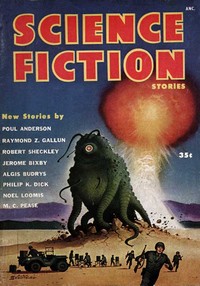
Ask a Foolish Question
Written by Robert Sheckley
Chaptra reads alongside you — AI insights, chapter breakdowns and reader discussions for every book. Join free
About this book
Reading guide
Themes, characters and key ideas in Ask a Foolish Question, written by Chaptra AI.
- about 8 hours
- intermediate
- Philosophical
- Thought-provoking
- Intriguing
Robert Sheckley's "Ask a Foolish Question" is a thought-provoking science fiction story from the early 1950s that delves into the philosophical nature of knowledge and the art of inquiry. It centers on the Answerer, a universal entity designed to provide ultimate truths, and the various beings who seek its wisdom. The narrative follows Morran and Lingman on their quest for profound answers, only to discover that the quality of the response is entirely dependent on the depth and precision of the question posed. The story masterfully highlights the limitations of human understanding, suggesting that without a foundational grasp of a subject, even an omniscient source cannot provide meaningful insights. Ultimately, it serves as a poignant reflection on the complex interplay between comprehension, curiosity, and the elusive nature of truth itself.
“The Answerer can only respond to questions framed correctly.”
Key themes
- The Nature of Knowledge and Inquiry
- This is the core theme of the story, exploring how knowledge is acquired and the critical role of well-formed questions. It posits that merely having access to information is insufficient; true understanding requires the ability to formulate precise, informed inquiries and possess the foundational knowledge to interpret the responses. The story argues that the 'answer' is often less important than the 'question'.
- Human Limitations and Hubris
- The story subtly critiques humanity's intellectual hubris and its inherent limitations. It suggests that while humans possess a powerful drive for knowledge, they often overestimate their capacity to comprehend ultimate truths without significant preparatory intellectual work. The Answerer acts as an impartial mirror, reflecting these limitations rather than solving them directly.
- The Pursuit of Truth and Meaning
- At its heart, the story is about the existential human quest for meaning and fundamental truths. It portrays this pursuit as a difficult, often frustrating endeavor, where the path to enlightenment is less about finding a definitive answer and more about the rigorous process of seeking, questioning, and growing intellectually.
Worth discussing
How does the story challenge our perception of 'knowledge' and 'truth'?
Chapter-by-chapter breakdowns, character arcs and the full thematic analysis come with a free account.
Discussions
No one has started one yet
Questions this book opens up
No discussions yet
Be the first to start a discussion about this book!
Sign up to start the discussionReviews
No reviews yet
Be the first to review this book!