
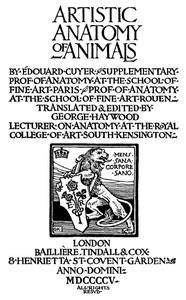
Artistic Anatomy of Animals
Written by Édouard Cuyer
Chaptra reads alongside you — AI insights, chapter breakdowns and reader discussions for every book. Join free
About this book
Reading guide
Themes, characters and key ideas in Artistic Anatomy of Animals, written by Chaptra AI.
- about 15 hours
- advanced
- educational
- informative
- analytical
Édouard Cuyer's "Artistic Anatomy of Animals" is a foundational early 20th-century scientific publication designed to equip artists with a deep understanding of animal anatomical structures. Recognizing the gap in artistic education, Cuyer meticulously compiles lessons on comparative anatomy, emphasizing its direct relevance for creating accurate and dynamic artistic representations. The work systematically introduces the principles of comparative anatomy, illustrating the similarities and differences between human and various animal forms. By providing this detailed anatomical knowledge, the book aims to empower artists to move beyond superficial observation, fostering a more informed and expressive approach to depicting animal subjects in their art.
“"The artist, no less than the scientist, must understand the hidden machinery beneath the surface to truly capture the essence of life."”
Key themes
- The Intersection of Art and Science
- This theme explores how scientific knowledge, specifically anatomy, is not merely supplementary but fundamental to achieving artistic mastery. Cuyer argues that a deep understanding of underlying biological structures allows artists to create more accurate, dynamic, and believable representations of animals, bridging the perceived gap between empirical observation and creative interpretation. It champions the idea that science can inform and enrich artistic practice.
- The Importance of Comparative Anatomy
- Cuyer places significant emphasis on comparative anatomy as a key pedagogical tool. This theme highlights the value of studying anatomical similarities and differences across species, enabling artists to understand universal biological principles and specific adaptations. It provides a framework for extrapolating knowledge from one animal type to another, fostering a more intuitive and comprehensive grasp of animal form and function.
- Mastery Through Knowledge and Observation
- This theme underscores the idea that true artistic mastery, particularly in realistic depiction, comes from a combination of diligent observation and deep foundational knowledge. Cuyer's work advocates for moving beyond superficial imitation, encouraging artists to understand the 'why' behind the 'what.' It suggests that informed observation, guided by anatomical understanding, leads to more profound and convincing artistic creations.
Worth discussing
How does a scientific understanding of anatomy enhance artistic expression, rather than limit it?
Chapter-by-chapter breakdowns, character arcs and the full thematic analysis come with a free account.
Discussions
No one has started one yet
Questions this book opens up
No discussions yet
Be the first to start a discussion about this book!
Sign up to start the discussionReviews
No reviews yet
Be the first to review this book!