
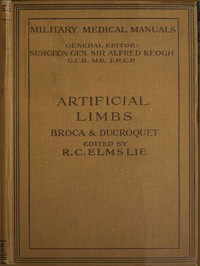
Artificial Limbs
Written by Auguste Broca,Charles Ducroquet
Chaptra reads alongside you — AI insights, chapter breakdowns and reader discussions for every book. Join free
About this book
Read it with a club
Chaptra's history and war clubs — small groups reading the same books and talking as they go.


Footnotes & Firefights
History and war
- 4 members
- 4 discussions
- Active Sep 11
Military history, from grand strategy down to the deeply boring logistics that actually decided everything. This is a Chaptra house club — set up and moderated by us to get the conversation going. Open to everyone; jump in anywhere.
Read Artificial Limbs alongside people who are reading it too.
Also here: Empire, Reconsidered
Chaptra Prime — paid clubs, every club feature, and unlimited reading support, for $5 a month or $60 once.
See PrimeReading guide
Themes, characters and key ideas in Artificial Limbs, written by Chaptra AI.
- about 8 hours
- advanced
- informative
- practical
- scientific
Artificial Limbs" by Auguste Broca and Charles Ducroquet is a pivotal early 20th-century scientific treatise detailing the design and manufacture of prosthetics, primarily for World War I amputees. The work systematically outlines the then-current principles and innovative practices in prosthetic development, emphasizing functionality, sound engineering, and individualized adaptation over mere aesthetic resemblance. Born from the authors' extensive experience with disabled veterans, it serves as both a practical guide and a testament to the rapid advancements in military medicine in response to unprecedented wartime injuries. This foundational text highlights the critical need for effective rehabilitation and improved quality of life for those impacted by limb loss.
“The primary objective of an artificial limb must always be function, not mere aesthetic mimicry of the natural form.”
Key themes
- Functionality Over Aesthetics
- This is a cornerstone principle of the book, advocating for prosthetic designs that prioritize practical utility, mobility, and the ability to perform daily tasks over a mere cosmetic resemblance to a natural limb. This theme reflects a pragmatic response to the severe and widespread injuries of WWI, recognizing that true rehabilitation requires enabling independence rather than simply masking disability.
- Application of Engineering Principles to Medicine
- The book champions the integration of sound engineering and mechanical principles into the design and manufacture of artificial limbs. This theme underscores the interdisciplinary nature of prosthetic development, emphasizing biomechanics, material science, and structural integrity to create durable, effective, and comfortable devices.
- Individualized Adaptation and Customization
- Recognizing the unique nature of each amputation and each individual's needs, the book stresses the importance of adapting prosthetic solutions. This theme highlights that a 'one-size-fits-all' approach is insufficient, advocating for tailored designs, fitting, and rehabilitation plans based on the specific type of limb loss, the individual's lifestyle, and their personal recovery journey.
Worth discussing
How did the unique challenges of World War I drive innovation in prosthetic design, and what parallels can be drawn to modern conflicts?
Chapter-by-chapter breakdowns, character arcs and the full thematic analysis come with a free account.
Discussions
No one has started one yet
Questions this book opens up
No discussions yet
Be the first to start a discussion about this book!
Sign up to start the discussionReviews
No reviews yet
Be the first to review this book!