
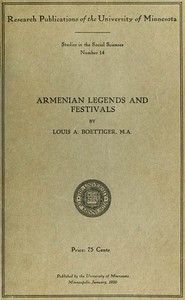
Armenian legends and festivals
Written by Louis A. (Louis Angelo) Boettiger
Chaptra reads alongside you — AI insights, chapter breakdowns and reader discussions for every book. Join free
About this book
Reading guide
Themes, characters and key ideas in Armenian legends and festivals, written by Chaptra AI.
- about 12 hours
- advanced
- Informative
- Scholarly
- Cultural
Louis A. Boettiger's "Armenian Legends and Festivals" is a foundational early 20th-century scholarly work that meticulously documents and analyzes the rich tapestry of Armenian folklore and cultural practices. The book explores how these ancient and Christian traditions have profoundly shaped Armenian national identity and ensured cultural continuity, particularly in the face of historical upheaval and diaspora. Boettiger's study serves to illuminate the complex interplay between history, mythology, and social customs, aiming to fill a significant void in accessible English-language materials on Armenian culture. It begins by establishing the geographical context before delving into pivotal legends like those of Haic, Ara and Semiramis, and Vahakn, interpreting their deep sociocultural and historical implications.
“The necessity of authentic studies of Armenia is paramount, given the significant lack of accessible materials in English.”
Key themes
- National Identity & Origin
- The book meticulously explores how foundational myths and historical narratives embedded in folklore construct and reinforce a distinct Armenian national identity. Legends like Haic's defiance provide a shared origin story, a sense of collective purpose, and a historical lineage that binds the people, emphasizing their unique heritage and sovereignty.
- Cultural Continuity & Resilience
- Boettiger highlights how folklore and festivals act as vital conduits for preserving cultural memory and tradition across generations, even through periods of immense political upheaval, displacement, and genocide. They are mechanisms by which a people maintain their distinctiveness and sense of self despite external pressures, ensuring the survival of their unique heritage.
- Interplay of Pagan & Christian Traditions
- The study examines the fascinating syncretic nature of Armenian culture, where ancient pagan beliefs and practices often blend seamlessly with, or are reinterpreted through, the lens of Christianity. Armenia was the first nation to adopt Christianity as a state religion, leading to a complex layering of spiritual meaning where old gods and rituals found new expression within the Christian framework.
Worth discussing
How does Boettiger's work exemplify early 20th-century approaches to folklore and ethnography? What are its strengths and limitations from a modern perspective?
Chapter-by-chapter breakdowns, character arcs and the full thematic analysis come with a free account.
Discussions
No one has started one yet
Questions this book opens up
No discussions yet
Be the first to start a discussion about this book!
Sign up to start the discussionReviews
No reviews yet
Be the first to review this book!