
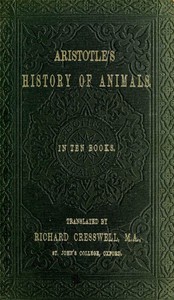
About this book
Reading guide
Themes, characters and key ideas in Aristotle's History of Animals: In Ten Books, written by Chaptra AI.
- about 50 hours
- advanced
- Analytical
- Systematic
- Observational
Aristotle's "History of Animals" is a monumental scientific treatise from the late 4th century BC, serving as a foundational text in zoology and the broader biological sciences. Across ten books, Aristotle meticulously surveys the animal kingdom, classifying species based on their anatomy, behaviors, habitats, and reproductive methods. The work systematically combines direct empirical observation with inherited knowledge, establishing a rigorous framework for understanding the natural world. It pioneered comparative anatomy and laid the groundwork for future scientific inquiry into biodiversity, making it an indispensable document in the history of science and philosophy.
“In all animals there are two chief parts, the uniform and the non-uniform parts; the uniform are such as flesh, bone, sinew, membrane, blood, fat, marrow, phlegm, bile, and the like; the non-uniform are such as the face, the hand, the foot, and the like.”
Key themes
- Empirical Observation and Inductive Reasoning
- Aristotle championed the systematic collection of data through direct observation as the primary method for understanding the natural world. He meticulously described animal anatomy, behavior, and habitats, then sought to derive general principles and classifications from these specific observations. This inductive approach was groundbreaking, emphasizing the importance of empirical evidence over pure speculation and setting a precedent for scientific inquiry.
- Classification and Taxonomy
- A central aim of the "History of Animals" is to organize the vast diversity of animal life into coherent categories. Aristotle classified animals based on shared anatomical features (e.g., presence or absence of blood, number of limbs), modes of life (aquatic, terrestrial), and reproductive strategies (viviparous, oviparous). While his system differs from modern taxonomy, it was the first comprehensive attempt to create a hierarchical structure for understanding biological relationships.
- Teleology and Purpose in Nature
- Aristotle's biological investigations are deeply intertwined with his philosophical concept of teleology—the idea that all natural phenomena, including the structures and behaviors of animals, are directed towards a specific end or purpose. He believed that nature does nothing in vain, and every part of an animal, every instinct, serves a function for the animal's survival, reproduction, or well-being within its species. This provided a powerful framework for understanding complex biological systems, even if it sometimes led to preconceived notions.
Worth discussing
How revolutionary was Aristotle's empirical approach for its time, and what were its inherent limitations given the lack of modern scientific tools?
Chapter-by-chapter breakdowns, character arcs and the full thematic analysis come with a free account.
Discussions
No one has started one yet
Questions this book opens up
No discussions yet
Be the first to start a discussion about this book!
Sign up to start the discussionReviews
No reviews yet
Be the first to review this book!