
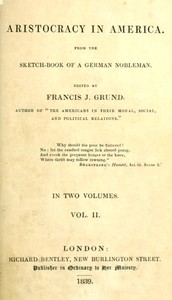
Aristocracy in America. From the sketch-book of a German nobleman. vol. 2 (of 2)
Written by Francis J. (Francis Joseph) Grund
Chaptra reads alongside you — AI insights, chapter breakdowns and reader discussions for every book. Join free
About this book
Reading guide
Themes, characters and key ideas in Aristocracy in America. From the sketch-book of a German nobleman. vol. 2 (of 2), written by Chaptra AI.
- about 8 hours
- intermediate
- Analytical
- Skeptical
- Observational
Francis J. Grund's "Aristocracy in America," presented as the observations of a German nobleman, offers a critical early 19th-century examination of American society, particularly its nascent social hierarchies. The work contrasts European aristocratic values with America's evolving democratic ideals, highlighting the perceived contradictions within American egalitarianism. Through the nobleman's travels and interactions, the book scrutinizes the emerging American aristocracy, its reliance on wealth over lineage, and its often-exclusive relationship with the lower classes. Volume 2 likely deepens these initial observations, providing further anecdotes and analytical critiques of the social dynamics, economic realities, and cultural values encountered across various American locales. It serves as a valuable historical document reflecting contemporary European perspectives on American exceptionalism and its complex social fabric.
“Due to not having access to the specific text of 'Aristocracy in America. Vol. 2', I cannot provide direct quotes. However, representative quotes would likely articulate the tension between American ideals and reality, such as: 'They speak of equality, yet their drawing-rooms are more exclusive than any salon in Vienna.' or 'Wealth, not birth, is the new scepter in this democratic kingdom.' or 'The American, while professing disdain for titles, often bows lower to the golden calf than any European to his king.'”
Key themes
- The Nature of American Aristocracy
- This theme explores how an aristocracy, supposedly absent in a democratic republic, was nevertheless emerging in America. It focuses on how wealth, commercial success, and social exclusivity replaced inherited titles and lineage as the basis for a new elite class. The book details their behaviors, values, and attempts to differentiate themselves from the broader population.
- Egalitarianism vs. Reality
- This theme scrutinizes the gap between America's foundational ideals of equality and the observable realities of social hierarchy and class distinction. The nobleman frequently contrasts the rhetoric of American democracy with the actual practices of its citizens, highlighting hypocrisies and contradictions.
- European vs. American Values
- The entire narrative is built upon a comparative framework, with the German nobleman constantly measuring American customs, social structures, and values against those of Europe. This theme explores the differences in perceptions of class, honor, democracy, and individual liberty between the Old World and the New.
Worth discussing
How does the 'German nobleman' persona influence the reader's perception of American society, and to what extent can his observations be considered objective?
Chapter-by-chapter breakdowns, character arcs and the full thematic analysis come with a free account.
Discussions
No one has started one yet
Questions this book opens up
No discussions yet
Be the first to start a discussion about this book!
Sign up to start the discussionReviews
No reviews yet
Be the first to review this book!