
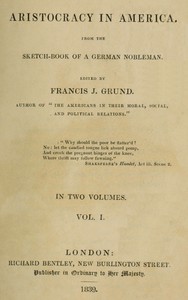
Aristocracy in America. From the sketch-book of a German nobleman. vol. 1 (of 2)
Written by Francis J. (Francis Joseph) Grund
Chaptra reads alongside you — AI insights, chapter breakdowns and reader discussions for every book. Join free
About this book
Reading guide
Themes, characters and key ideas in Aristocracy in America. From the sketch-book of a German nobleman. vol. 1 (of 2), written by Chaptra AI.
- about 8 hours
- intermediate
- satirical
- observational
- critical
Francis J. Grund's "Aristocracy in America: From the Sketch-Book of a German Nobleman, Vol. 1" offers a satirical and critical examination of American society in the early 19th century through the eyes of a European aristocrat. The work delves into the paradox of a republic founded on equality yet exhibiting strong aspirations towards aristocratic status and class distinctions. Through a series of observations, anecdotes, and reported conversations, the book exposes the social pretensions and ironic disdain for democratic principles among America's burgeoning upper class. It serves as a significant historical document, shedding light on the cultural dynamics and societal aspirations that challenged the foundational ideals of the young nation.
“"It is not enough to be rich in America; one must also pretend to have been rich for generations, even if one's fortune was made yesterday."”
Key themes
- American Aristocracy and Social Pretension
- This is the central theme, exploring how a nation founded on egalitarian principles nonetheless develops a distinct social hierarchy and a class of people aspiring to aristocratic status. The book details their attempts to establish social distinctions based on wealth, perceived lineage, and cultural emulation of European nobility, often through snobbery and exclusionary practices.
- The Conflict of Democratic Ideals vs. Social Reality
- The book starkly contrasts America's foundational ideals of liberty, equality, and republicanism with the observed social realities of class distinction and aristocratic aspiration. It highlights the hypocrisy of individuals who outwardly champion democratic principles while privately or publicly striving for social superiority and exclusivity.
- European vs. American Identity and Perceptions
- Through the German nobleman's observations, the book explores the cultural dialogue and often critical perceptions between Europe and America. It examines how Americans, despite their revolutionary break from Europe, often looked to European aristocracy for models of refinement and status, while Europeans viewed American society with a mix of curiosity, admiration, and disdain.
Worth discussing
How does Grund, through the German nobleman, challenge the popular image of America as a land of pure equality and opportunity?
Chapter-by-chapter breakdowns, character arcs and the full thematic analysis come with a free account.
Discussions
No one has started one yet
Questions this book opens up
No discussions yet
Be the first to start a discussion about this book!
Sign up to start the discussionReviews
No reviews yet
Be the first to review this book!