
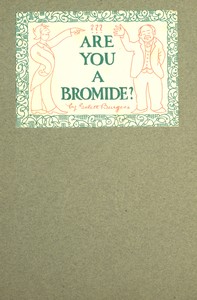
Are You a Bromide?: The Sulphitic Theory Expounded and Exemplified According to the Most Recent Researches into the Psychology of Boredom, Including Many Well-Known Bromidioms Now in Use
Written by Gelett Burgess
Chaptra reads alongside you — AI insights, chapter breakdowns and reader discussions for every book. Join free
About this book
Reading guide
Themes, characters and key ideas in Are You a Bromide?: The Sulphitic Theory Expounded and Exemplified According to the Most Recent Researches into the Psychology of Boredom, Including Many Well-Known Bromidioms Now in Use, written by Chaptra AI.
- about 8 hours
- intermediate
- humorous
- satirical
- insightful
Gelett Burgess's "Are You a Bromide?" is a satirical early 20th-century essay that ingeniously categorizes individuals into two distinct psychological types: the predictable 'Bromides' and the spontaneous 'Sulphites'. Through a humorous yet incisive lens, Burgess explores the societal implications of conformity versus originality, dissecting the nature of conversation, social interaction, and the pervasive phenomenon of boredom. The work introduces the enduring concept of "Bromidioms"—clichéd expressions indicative of unoriginal thought—to highlight the differences between those who adhere to established norms and those who challenge them. Ultimately, it serves as both a witty social commentary and an encouragement for readers to embrace authentic, independent thought over conventionality.
“The world is divided into two classes: Bromides and Sulphites.”
Key themes
- Conformity vs. Originality
- This is the central thematic tension of the essay. Burgess meticulously explores how societal pressures and the comfort of convention lead individuals to become 'Bromides,' echoing established thoughts and patterns. Conversely, he champions 'Sulphites' as those who dare to think independently, challenge norms, and bring fresh perspectives, highlighting the value and often the social friction associated with originality.
- The Psychology of Boredom
- Burgess explicitly links the prevalence of Bromides and their predictable interactions to the widespread experience of boredom. He suggests that the lack of original thought and spontaneity in social discourse creates a monotonous and unstimulating environment, leading to intellectual and emotional ennui. The Sulphite, by contrast, offers an antidote to this boredom through their dynamic and unpredictable nature.
- Social Interaction and Communication
- The essay provides a keen analysis of how different personality types shape social interactions and the quality of communication. Burgess illustrates how Bromides seek comfort in predictable exchanges, while Sulphites introduce disruption, leading to either heightened engagement or awkwardness. It delves into the unspoken rules of conversation and how adherence to or deviation from these rules defines social dynamics.
Worth discussing
How relevant are Burgess's categories of Bromides and Sulphites in contemporary society, particularly with the rise of social media?
Chapter-by-chapter breakdowns, character arcs and the full thematic analysis come with a free account.
Discussions
No one has started one yet
Questions this book opens up
No discussions yet
Be the first to start a discussion about this book!
Sign up to start the discussionReviews
No reviews yet
Be the first to review this book!