
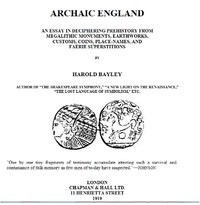
Archaic England : $b an essay in deciphering prehistory from megalithic monuments, earthworks, customs, coins, place-names, and faerie superstitions
Written by Harold Bayley
Chaptra reads alongside you — AI insights, chapter breakdowns and reader discussions for every book. Join free
About this book
Reading guide
Themes, characters and key ideas in Archaic England : $b an essay in deciphering prehistory from megalithic monuments, earthworks, customs, coins, place-names, and faerie superstitions, written by Chaptra AI.
- about 15 hours
- advanced
- Scholarly
- Investigative
- Mysterious
Harold Bayley's "Archaic England" is an ambitious early 20th-century historical essay that endeavors to reconstruct English prehistory by synthesizing evidence from disparate fields. The author proposes a multidisciplinary approach, examining megalithic monuments, earthworks, ancient customs, numismatics, place-names, and even faerie superstitions. Bayley critiques existing historical and archaeological methodologies, advocating for a holistic interpretation to reveal the narratives of pre-literate societies. The work aims to demonstrate how these seemingly unrelated fragments can collectively illuminate the foundational cultures and beliefs that shaped modern England, offering a speculative yet comprehensive vision of its ancient past.
“The prehistory of England is a tapestry woven from threads of stone, earth, custom, coin, and whispered tale.”
Key themes
- Deciphering Prehistory
- The central intellectual challenge explored by Bayley is the very act of reconstructing the past before written records. He grapples with the fragmented nature of evidence and the interpretative leaps required to piece together narratives of ancient cultures, advocating for a methodology that moves beyond mere description to meaningful interpretation.
- Multidisciplinary Inquiry
- Bayley's core thesis rests on the necessity of integrating insights from diverse academic fields—archaeology, linguistics, folklore, numismatics—to achieve a comprehensive understanding of prehistory. He argues against disciplinary silos, proposing that a holistic perspective reveals connections and patterns invisible to specialized study.
- The Persistence of Ancient Beliefs and Customs
- A significant theme is Bayley's conviction that ancient beliefs, rituals, and even historical memories persist into later eras, often in disguised or fragmented forms. He views customs, place-names, and especially faerie superstitions not as mere relics but as living echoes of prehistoric cultures, carrying deep symbolic and historical weight.
Worth discussing
Discuss Bayley's multidisciplinary approach. Is it more effective than specialized studies for understanding prehistory, or does it risk over-interpretation?
Chapter-by-chapter breakdowns, character arcs and the full thematic analysis come with a free account.
Discussions
No one has started one yet
Questions this book opens up
No discussions yet
Be the first to start a discussion about this book!
Sign up to start the discussionReviews
No reviews yet
Be the first to review this book!