
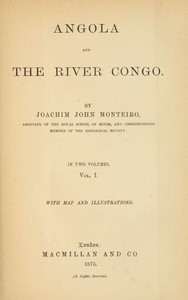
Angola and the River Congo, vol. 1
Written by Joachim John Monteiro
Chaptra reads alongside you — AI insights, chapter breakdowns and reader discussions for every book. Join free
About this book
Read it with a club
Small groups reading the same books and talking as they go.


News
- 4 members
- 1,813 discussions
- Active Sep 11
Read Angola and the River Congo, vol. 1 alongside people who are reading it too.
Also here: News Bulletin, Just Joking....
Chaptra Prime — paid clubs, every club feature, and unlimited reading support, for $5 a month or $60 once.
See PrimeReading guide
Themes, characters and key ideas in Angola and the River Congo, vol. 1, written by Chaptra AI.
- about 25 hours
- advanced
- Informative
- Observational
- Historical
Joachim John Monteiro's "Angola and the River Congo, vol. 1" is a pivotal late 19th-century historical account that meticulously details the landscapes, cultures, and history of Angola and the Congo River region. The book interweaves the author's personal travel experiences and explorations with a comprehensive historical narrative, beginning with the early Portuguese colonization efforts. Monteiro vividly recounts the arrival of Portuguese settlers, their complex interactions with local chiefs, and the evolving dynamics of power, conflict, and trade that shaped the region's early colonial history. This initial volume establishes a foundational understanding of the area's geography, the diverse indigenous tribes, and the profound impact of European influence, setting a detailed and observant tone for subsequent explorations.
“The arrival of the Portuguese marked not merely a new chapter, but the very genesis of a transformed landscape, both geographical and political, for the ancient kingdoms of Angola.”
Key themes
- Colonialism and its Impact
- This is the overarching theme, explored through the historical accounts of Portuguese expansion, the establishment of trade routes (implicitly including the slave trade), resource exploitation, and the imposition of European power structures. Monteiro details the initial relationships, subsequent conflicts, and the lasting effects of foreign rule on the local populations and landscape.
- Exploration and Discovery
- This theme encompasses Monteiro's personal journeys into uncharted territories, his scientific observations, and the general European drive to map, categorize, and claim new lands. It highlights the spirit of adventure and the pursuit of knowledge (and resources) that characterized the era.
- Cultural Encounter and Ethnography
- Monteiro dedicates significant portions of his work to describing the various indigenous tribes he encounters, detailing their customs, social structures, beliefs, and daily lives. While valuable, this ethnographic effort is inherently shaped by a 19th-century European perspective, offering insights into both African societies and the colonial gaze.
Worth discussing
How does Monteiro's 19th-century perspective shape his portrayal of indigenous African cultures and the colonial project?
Chapter-by-chapter breakdowns, character arcs and the full thematic analysis come with a free account.
Discussions
No one has started one yet
Questions this book opens up
No discussions yet
Be the first to start a discussion about this book!
Sign up to start the discussionReviews
No reviews yet
Be the first to review this book!