
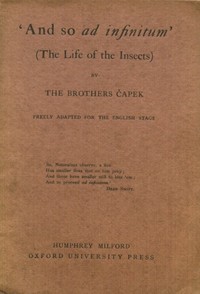
'And So Ad Infinitum' (The Life of the Insects): An Entomological Review, in Three Acts, a Prologue and an Epilogue
Written by Karel Čapek,Josef Čapek
Chaptra reads alongside you — AI insights, chapter breakdowns and reader discussions for every book. Join free
About this book
Reading guide
Themes, characters and key ideas in 'And So Ad Infinitum' (The Life of the Insects): An Entomological Review, in Three Acts, a Prologue and an Epilogue, written by Chaptra AI.
- about 8 hours
- intermediate
- satirical
- philosophical
- melancholy
Karel and Josef Čapek's 'And So Ad Infinitum' (The Life of the Insects) is a profound allegorical play that uses the lives of various insect species to satirize human society and its inherent flaws. Structured as an 'entomological review' across a prologue, three acts, and an epilogue, the work exposes the absurdity, materialism, nationalism, and destructive tendencies of humanity through personified insects. From the fleeting romances of butterflies to the militaristic fervor of ants, the play critiques human nature, ultimately concluding with a melancholic reflection on the cyclical nature of life, death, and human folly, all observed through the eyes of a philosophical tramp.
“Oh, to be a butterfly! To live for a day and a night, to dance, to love, to die without thought or care!”
Key themes
- Human Folly and Absurdity
- The central theme, explored through every insect segment. The play consistently highlights the irrationality, pettiness, and self-destructive tendencies of human beings by magnifying them in the insect world. From the triviality of butterfly love to the senselessness of ant warfare, human endeavors are presented as often absurd and ultimately meaningless in the grand scheme.
- War and Nationalism
- Most vividly portrayed in the 'Ants' act, this theme is a scathing critique of the irrationality and brutality of warfare, fueled by jingoism, propaganda, and blind obedience. The Čapek brothers, writing in the aftermath of WWI, expose how abstract ideals like 'nation' or 'glory' lead to immense suffering and destruction for trivial gains.
- The Cycle of Life and Death
- Underpinning the entire play is the relentless, indifferent cycle of existence. Each act shows birth, struggle, reproduction, and death, often brutally and without grand meaning. The play begins with new life (butterflies) and ends with the Tramp's death juxtaposed with the emergence of a new insect, emphasizing the ceaseless flow of nature regardless of individual or societal drama.
Worth discussing
How effective is the insect allegory in critiquing human society? What are its strengths and limitations?
Chapter-by-chapter breakdowns, character arcs and the full thematic analysis come with a free account.
Discussions
No one has started one yet
Questions this book opens up
No discussions yet
Be the first to start a discussion about this book!
Sign up to start the discussionReviews
No reviews yet
Be the first to review this book!