
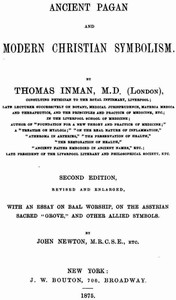
Ancient Pagan and Modern Christian Symbolism: With an Essay on Baal Worship, on the Assyrian Sacred "Grove," and Other Allied Symbols
Written by Thomas Inman,John Newton
Chaptra reads alongside you — AI insights, chapter breakdowns and reader discussions for every book. Join free
About this book
Read it with a club
Small groups reading the same books and talking as they go.


News
- 4 members
- 1,813 discussions
- Active Sep 11
Read Ancient Pagan and Modern Christian Symbolism: With an Essay on Baal Worship, on the Assyrian Sacred "Grove," and Other Allied Symbols alongside people who are reading it too.
Also here: News Bulletin, Just Joking....
Chaptra Prime — paid clubs, every club feature, and unlimited reading support, for $5 a month or $60 once.
See PrimeReading guide
Themes, characters and key ideas in Ancient Pagan and Modern Christian Symbolism: With an Essay on Baal Worship, on the Assyrian Sacred "Grove," and Other Allied Symbols, written by Chaptra AI.
- about 12 hours
- advanced
- analytical
- historical
- controversial
Thomas Inman and John Newton's "Ancient Pagan and Modern Christian Symbolism" is a late 19th-century historical account that meticulously explores the profound and often overlooked connections between ancient pagan symbolism and Christian iconography. The authors argue that numerous symbols, rituals, and beliefs within Christianity have direct antecedents in older pagan traditions, illustrating a continuity of human religious expression across millennia. They begin by establishing the universal importance of symbolism in religious practice and the varying interpretations across cultures, setting the stage for a detailed examination of specific emblems and their evolving meanings. The work aims to challenge conventional understandings of religious origins by demonstrating a deep syncretism and shared symbolic language between seemingly distinct faiths. Through extensive comparative analysis, Inman and Newton illuminate how these ancient concepts have persisted and adapted, shaping modern religious practices and beliefs.
“"The symbols of all religions, however divergent their creeds, have had a common origin in the universal experiences of humanity."”
Key themes
- Symbolic Continuity and Syncretism
- This is the core theme, arguing that religious symbols and practices are not isolated creations but evolve and are absorbed from earlier traditions. The book meticulously traces how pagan symbols found new meanings and forms within Christianity, illustrating a continuous thread of human symbolic expression across different cultures and eras.
- The Universal Nature of Human Spirituality
- The book implicitly argues for a fundamental, shared human tendency to create and imbue symbols with sacred meaning. It suggests that despite vast cultural and temporal differences, humanity grapples with similar existential questions and expresses spiritual insights through recurring symbolic archetypes. This universality underpins the possibility of symbolic continuity.
- Historical-Critical Approach to Religion
- Inman and Newton exemplify a historical-critical approach to religion, treating religious texts, symbols, and practices as historical phenomena subject to human influence, evolution, and cultural borrowing, rather than purely divine revelation. They emphasize empirical evidence and comparative analysis over theological dogma, aiming to uncover the historical development of religious forms.
Worth discussing
To what extent do Inman and Newton successfully demonstrate a direct lineage between pagan and Christian symbols? What are the strongest and weakest examples they present?
Chapter-by-chapter breakdowns, character arcs and the full thematic analysis come with a free account.
Discussions
No one has started one yet
Questions this book opens up
No discussions yet
Be the first to start a discussion about this book!
Sign up to start the discussionReviews
No reviews yet
Be the first to review this book!