
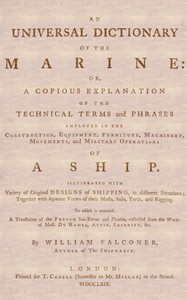
An Universal Dictionary of the Marine: Or, a Copious Explanation of the Technical Terms and Phrases Employed in the Construction, Equipment, Furniture, Machinery, Movements, and Military Operations of a Ship. Illustrated With Variety of Original Designs of Shipping, in Different Situations; Together With Separate Views of Their Masts, Sails, Yards, and Rigging. to Which Is Annexed, a Translation of the French Sea-terms and Phrases, Collected from the Works of Mess. Du Hamel, Aubin, Saverien, &c.
Written by William Falconer
Chaptra reads alongside you — AI insights, chapter breakdowns and reader discussions for every book. Join free
About this book
Reading guide
Themes, characters and key ideas in An Universal Dictionary of the Marine: Or, a Copious Explanation of the Technical Terms and Phrases Employed in the Construction, Equipment, Furniture, Machinery, Movements, and Military Operations of a Ship. Illustrated With Variety of Original Designs of Shipping, in Different Situations; Together With Separate Views of Their Masts, Sails, Yards, and Rigging. to Which Is Annexed, a Translation of the French Sea-terms and Phrases, Collected from the Works of Mess. Du Hamel, Aubin, Saverien, &c., written by Chaptra AI.
- about 200 hours
- advanced
- informative
- authoritative
- technical
William Falconer's "An Universal Dictionary of the Marine" is a monumental 18th-century reference work, meticulously cataloging the technical terms and phrases essential to naval architecture, equipment, navigation, and military operations at sea. Driven by a perceived inadequacy in prior maritime lexicons, Falconer aimed to provide an unparalleled resource for a sea-faring nation, emphasizing clarity, detail, and practical application. The dictionary meticulously defines thousands of terms, often with etymological notes and accompanied by original illustrations of ships and their components. It stands as a testament to the Age of Enlightenment's drive for systematization and a crucial historical document reflecting the zenith of sail power.
“It has been observed, that almost every art, science, and profession, has its peculiar language, or certain terms and phrases, which are only understood by those who have been regularly instructed therein.”
Key themes
- Precision and Standardization of Language
- The central theme of the dictionary is the absolute necessity of precise and standardized language, particularly in complex technical fields like marine affairs. Falconer explicitly states his intent to rectify the ambiguities and inconsistencies of prior works, aiming to create a definitive lexicon where each term is clearly and unambiguously defined. This theme underscores the practical implications of language: miscommunication in maritime contexts could lead to disaster, making clarity paramount.
- The Importance of Maritime Power and Knowledge
- The dictionary implicitly and explicitly highlights the foundational importance of maritime strength—both commercial and military—to the British Empire. Creating such a comprehensive resource was not merely an academic exercise but a strategic imperative for a nation whose power and prosperity were inextricably linked to its naval capabilities and global trade. The definitions often extend beyond mere technical explanation to contextualize terms within naval operations, warfare, and economic activities.
- Enlightenment Era Classification and Systematization
- Falconer's dictionary is a quintessential product of the Enlightenment, reflecting the era's profound intellectual drive to classify, systematize, and disseminate knowledge. The very act of compiling such a comprehensive lexicon, with its emphasis on order, rationality, and exhaustive detail, aligns perfectly with the broader encyclopedic projects of the 18th century, such as Diderot's Encyclopédie. It represents an effort to bring order to a complex and often orally transmitted body of knowledge.
Worth discussing
How does a specialized dictionary like Falconer's reflect the cultural and economic priorities of its era, particularly for a maritime nation like Great Britain?
Chapter-by-chapter breakdowns, character arcs and the full thematic analysis come with a free account.
Discussions
No one has started one yet
Questions this book opens up
No discussions yet
Be the first to start a discussion about this book!
Sign up to start the discussionReviews
No reviews yet
Be the first to review this book!