
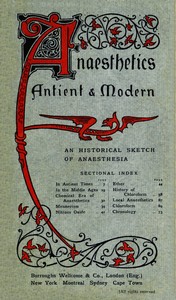
Anæsthetics antient and modern : $b An historical sketch of anæsthesia
Written by Burroughs Wellcome and Company
Chaptra reads alongside you — AI insights, chapter breakdowns and reader discussions for every book. Join free
About this book
Reading guide
Themes, characters and key ideas in Anæsthetics antient and modern : $b An historical sketch of anæsthesia, written by Chaptra AI.
- about 8 hours
- advanced
- informative
- historical
- scientific
Burroughs Wellcome and Company's "Anæsthetics antient and modern" offers a meticulous historical survey of anesthesia, tracing its evolution from rudimentary ancient practices to the groundbreaking scientific advancements of the late 19th century. This scientific publication meticulously chronicles the substances and methods employed for pain relief across various civilizations, highlighting the transformative discoveries of nitrous oxide, ether, and chloroform. It details the contributions of key figures like Horace Wells and W.T.G. Morton, whose work heralded a new era in surgical and dental medicine. The book serves as an invaluable document illustrating humanity's persistent quest to alleviate suffering and the triumph of scientific inquiry over ancient superstition, thereby cementing anesthesia's indispensable role in modern medical practice.
“From the rudimentary herbal concoctions of antiquity to the precise chemical agents of our modern era, the quest for insensibility has been a persistent thread in the tapestry of medicine.”
Key themes
- The Evolution of Scientific Knowledge
- This theme explores the progression of human understanding from ancient, often superstitious, remedies to the systematic, empirical, and chemical-based scientific methods of the modern era. It highlights how medical knowledge is built incrementally, often through trial-and-error, observation, and rigorous experimentation, leading to revolutionary breakthroughs.
- The Alleviation of Human Suffering
- This is the core motivation behind the entire historical narrative. The book implicitly and explicitly details the immense pain and trauma associated with surgery before anesthesia and celebrates the profound humanitarian impact of these discoveries. It underscores medicine's fundamental purpose to relieve pain and improve quality of life.
- Human Ingenuity and Discovery
- The text showcases the intellectual curiosity, perseverance, and innovative spirit of individuals who dared to experiment, challenge existing norms, and ultimately transform medical practice. It highlights the role of individual genius and collaborative effort in pushing the boundaries of what was thought possible.
Worth discussing
How did the transition from ancient, often superstitious, pain relief methods to scientific anesthesia reflect broader shifts in human understanding and scientific methodology?
Chapter-by-chapter breakdowns, character arcs and the full thematic analysis come with a free account.
Discussions
No one has started one yet
Questions this book opens up
No discussions yet
Be the first to start a discussion about this book!
Sign up to start the discussionReviews
No reviews yet
Be the first to review this book!