
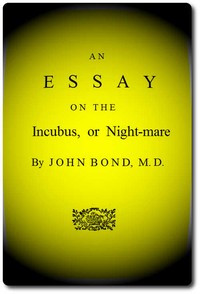
About this book
Reading guide
Themes, characters and key ideas in An Essay on the Incubus, or Night-mare, written by Chaptra AI.
- about 4 hours
- advanced
- Analytical
- Historical
- Medical
John Bond's 1753 treatise, "An Essay on the Incubus, or Night-mare," stands as a pivotal work in the medicalization of sleep disorders, systematically analyzing the phenomenon of the incubus from a physiological perspective. Challenging prevalent supernatural and folkloric interpretations, Bond meticulously details the symptoms, explores a range of potential physiological causes such as diet, digestion, and posture, and proposes rational medical remedies. This essay represents an early and significant attempt to apply scientific inquiry to a condition previously attributed to demonic influence, thereby contributing to the nascent fields of neurology and psychiatry. It offers invaluable insight into 18th-century medical thought and the gradual shift towards empirical observation in understanding human ailments.
“"The Incubus, or Night-mare, is a species of Apoplexy, affecting those who are asleep."”
Key themes
- Medicalization of Illness
- This essay is a prime example of the historical process by which conditions previously understood through supernatural or folkloric lenses became reinterpreted as medical problems. Bond's work systematically argues for a physiological basis for the incubus, moving it from the realm of demons and spirits into the domain of medical science and rational inquiry.
- Empirical Observation and Rationalism
- The essay is a testament to the Enlightenment's emphasis on empirical observation and rational deduction. Bond meticulously describes symptoms, categorizes potential causes, and proposes solutions based on observable phenomena and logical inference, rather than appealing to dogma or tradition. His work exemplifies the scientific method in its nascent stages, prioritizing evidence and reasoned argument.
- Mind-Body Connection
- Bond implicitly explores the intricate relationship between physical states and mental experiences. While primarily focusing on physiological causes, he acknowledges how bodily discomforts (like indigestion or impeded circulation) directly lead to terrifying mental sensations and visions during sleep. This early recognition of physical states profoundly influencing subjective experience is a precursor to modern psychosomatic medicine.
Worth discussing
How does Bond's essay reflect the broader intellectual currents of the Enlightenment, particularly the shift from supernatural to scientific explanations of phenomena?
Chapter-by-chapter breakdowns, character arcs and the full thematic analysis come with a free account.
Discussions
No one has started one yet
Questions this book opens up
No discussions yet
Be the first to start a discussion about this book!
Sign up to start the discussionReviews
No reviews yet
Be the first to review this book!