
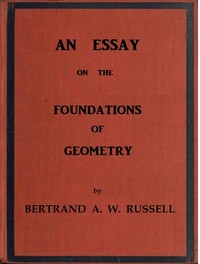
An essay on the foundations of geometry
Written by Bertrand Russell
Chaptra reads alongside you — AI insights, chapter breakdowns and reader discussions for every book. Join free
About this book
Reading guide
Themes, characters and key ideas in An essay on the foundations of geometry, written by Chaptra AI.
- about 15 hours
- advanced
- analytical
- rigorous
- challenging
Bertrand Russell's "An Essay on the Foundations of Geometry" is a pivotal late 19th-century philosophical inquiry dissecting the logical and epistemological underpinnings of geometry. The work meticulously explores historical perspectives, particularly the profound influence of Kant's philosophy and the revolutionary emergence of non-Euclidean geometries. Russell critically examines the essential axioms governing geometric thought, distinguishing between a priori knowledge and subjective experience to clarify the nature of spatial knowledge. Through rigorous analysis, he aims to establish a robust framework for understanding geometry's relationship with logic, marking a significant early contribution to analytic philosophy.
“Geometry, as a branch of pure mathematics, is concerned with the logical consequences of a set of definitions and axioms, without regard to their empirical truth.”
Key themes
- Epistemology of Geometry
- Russell deeply investigates the nature of geometric knowledge: how we acquire it, its certainty, and its justification. He questions whether geometric truths are empirical, a priori, or purely logical constructs, especially in light of non-Euclidean geometries. This theme explores the very basis of our understanding of space and its relationship to human cognition and reality.
- Challenge to Kantian Philosophy
- A central and defining thrust of the essay is to critically engage with and ultimately undermine Immanuel Kant's transcendental idealism, particularly his view that Euclidean geometry is a necessary, synthetic a priori condition for human experience. Russell employs the logical consistency of non-Euclidean geometries to demonstrate that Euclidean geometry is not uniquely privileged or universally necessary.
- Nature of Axioms and Logical Foundations
- Russell meticulously examines the role, status, and philosophical implications of axioms within geometric systems. He explores their independence, consistency, and how altering them leads to fundamentally different geometries. This theme underscores Russell's commitment to logicism, arguing that geometric truths derive their validity primarily from their logical structure and consistency rather than from empirical observation or intuitive certainty.
Worth discussing
How did the emergence of non-Euclidean geometries challenge long-held philosophical beliefs about the nature of space and truth?
Chapter-by-chapter breakdowns, character arcs and the full thematic analysis come with a free account.
Discussions
No one has started one yet
Questions this book opens up
No discussions yet
Be the first to start a discussion about this book!
Sign up to start the discussionReviews
No reviews yet
Be the first to review this book!