
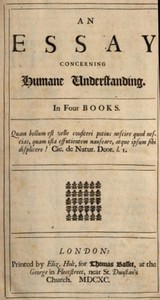
An Essay Concerning Humane Understanding, Volume 1: MDCXC, Based on the 2nd Edition, Books 1 and 2
Written by John Locke
Chaptra reads alongside you — AI insights, chapter breakdowns and reader discussions for every book. Join free
About this book
Reading guide
Themes, characters and key ideas in An Essay Concerning Humane Understanding, Volume 1: MDCXC, Based on the 2nd Edition, Books 1 and 2, written by Chaptra AI.
- about 15 hours
- advanced
- philosophical
- analytical
- foundational
John Locke's "An Essay Concerning Humane Understanding, Volume 1" (Books 1 & 2) lays the foundational arguments for empiricism, asserting that all human knowledge originates from sensory experience and reflection, rather than innate ideas. Locke systematically dismantles the doctrine of innate principles and ideas, arguing that the mind at birth is a 'tabula rasa' or blank slate. He then elaborates on how simple ideas are derived directly from sensation and reflection, forming the basic building blocks of all thought. These simple ideas are subsequently combined and abstracted by the mind to form complex ideas, encompassing modes, substances, and relations, thereby constructing the entirety of human understanding. The work profoundly influenced subsequent philosophical thought, particularly in epistemology and the philosophy of mind.
“No man's knowledge here can go beyond his experience.”
Key themes
- The Rejection of Innate Ideas
- Locke dedicates Book 1 to systematically dismantling the doctrine of innate ideas and principles. He argues that if ideas were innate, they would be universally present in all minds, including those of children and individuals with cognitive impairments, which he demonstrates is empirically false. He posits that even the most fundamental logical and moral principles are acquired through experience and learning, not pre-engraved in the mind. This theme is crucial as it clears the ground for his empiricist epistemology, asserting that the mind is not born with pre-existing knowledge.
- Empiricism and the Tabula Rasa
- This is the central tenet of Locke's philosophy. He asserts that the human mind at birth is a 'tabula rasa' – a blank slate – devoid of any innate content. All knowledge, therefore, must be acquired through experience. This experience is divided into two sources: 'sensation,' which provides ideas of external objects through the senses, and 'reflection,' which provides ideas of the mind's own internal operations. This theme establishes the experiential basis for all human understanding and challenges rationalist theories that emphasize innate reason or intuition as primary sources of knowledge.
- The Origin and Classification of Ideas
- Locke meticulously details how ideas are formed, distinguishing between 'simple ideas' and 'complex ideas.' Simple ideas are received passively by the mind from sensation or reflection and cannot be broken down further (e.g., specific colors, sounds, tastes, or acts of willing). Complex ideas, conversely, are actively formed by the mind through combining, comparing, or abstracting simple ideas. He classifies complex ideas into 'modes' (ideas that are dependent on substances, like beauty or gratitude), 'substances' (ideas of things that exist independently, like a man or a stone), and 'relations' (ideas that arise from comparing two or more ideas, like cause and effect). This systematic categorization is fundamental to understanding the architecture of human thought according to Locke.
Worth discussing
To what extent does Locke successfully refute the concept of innate ideas? Are there any modern arguments for innate knowledge that challenge his view?
Chapter-by-chapter breakdowns, character arcs and the full thematic analysis come with a free account.
Discussions
No one has started one yet
Questions this book opens up
No discussions yet
Be the first to start a discussion about this book!
Sign up to start the discussionReviews
No reviews yet
Be the first to review this book!