
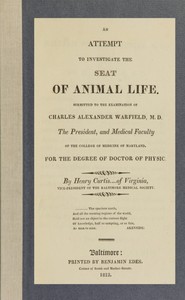
An Attempt to Investigate the Seat of Animal Life
Written by Henry Curtis
Chaptra reads alongside you — AI insights, chapter breakdowns and reader discussions for every book. Join free
About this book
Reading guide
Themes, characters and key ideas in An Attempt to Investigate the Seat of Animal Life, written by Chaptra AI.
- about 8 hours
- advanced
- Analytical
- Inquisitive
- Challenging
Henry Curtis's "An Attempt to Investigate the Seat of Animal Life" is an early 19th-century scientific essay that critically examines the fundamental principles governing vital functions in living systems. Curtis challenges contemporary physiological theories that attribute life solely to organic machinery or innate muscle vitality. Instead, he posits that the nervous system and brain are the central orchestrators of life and motion, with vital functions arising from their coordinated actions. The work methodically critiques prevailing fallacies, discussing elements like the role of blood and the impact of external stimuli, ultimately advocating for a rigorous, nervous-system-centric approach to understanding life and cautioning against unsubstantiated speculation in medical science.
“"An Attempt to Investigate the Seat of Animal Life" delves into the complexities of animal life, specifically exploring the principles behind vital functions and the intrinsic nature of living systems.”
Key themes
- The Seat of Animal Life
- This is the central scientific and philosophical inquiry of the book: identifying the true origin and coordinating center of vital functions and the intrinsic nature of living systems within the animal body.
- Critique of Prevailing Scientific Theories
- A core aspect of the essay is Curtis's systematic refutation of contemporary physiological ideas, showcasing a commitment to critical thinking and challenging established, but unproven, dogmas in the pursuit of scientific truth.
- Primacy of the Nervous System and Brain
- Curtis's central hypothesis posits that the brain and the broader nervous system are the fundamental coordinators of all vital functions, motion, and the very essence of life, a significant departure from earlier mechanistic or localized views.
Worth discussing
How does Curtis's critique of earlier physiologists reflect the scientific method of his time?
Chapter-by-chapter breakdowns, character arcs and the full thematic analysis come with a free account.
Discussions
No one has started one yet
Questions this book opens up
No discussions yet
Be the first to start a discussion about this book!
Sign up to start the discussionReviews
No reviews yet
Be the first to review this book!