
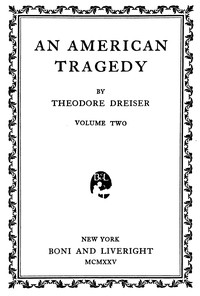
An American tragedy, v. 2
Written by Theodore Dreiser
Chaptra reads alongside you — AI insights, chapter breakdowns and reader discussions for every book. Join free
About this book
Reading guide
Themes, characters and key ideas in An American tragedy, v. 2, written by Chaptra AI.
- about 12 hours
- advanced
- tragic
- bleak
- naturalistic
Volume 2 of "An American Tragedy" plunges Clyde Griffiths deeper into a moral and social quagmire as his illicit affair with Roberta Alden results in pregnancy, threatening his aspirations for social climbing with the wealthy Sondra Finchley. Unable to reconcile his desires for status and comfort with his responsibility to Roberta, Clyde concocts a desperate plan that culminates in Roberta's death, an event shrouded in ambiguity between accident and murder. The narrative meticulously details the subsequent investigation, sensational trial, and Clyde's eventual conviction and execution, serving as a scathing indictment of societal pressures, the justice system, and the elusive nature of the American Dream. Dreiser portrays Clyde as a product of his environment, a weak-willed individual caught in a deterministic trap of circumstance and personal failing.
“"The world was not ready for such a spirit as he had, and he was not ready for the world. He was a creature of circumstance, a waif, a sport of chance, a victim of the forces that play upon the human soul."”
Key themes
- The American Dream and Social Ambition
- Dreiser dissects the darker side of the American Dream, showing how the relentless pursuit of wealth and status can corrupt individuals and lead to tragedy. Clyde's desire to escape his humble origins and achieve a life of luxury and social acceptance, epitomized by Sondra Finchley, drives his most desperate and ultimately fatal choices. The novel suggests that for those without inherent privilege or strong moral compass, this dream can be a destructive illusion.
- Morality, Guilt, and Consequence
- The novel deeply explores Clyde's internal struggle with morality and guilt following Roberta's death. Dreiser presents a nuanced view of culpability, suggesting that while Clyde is directly involved in Roberta's death, his actions are also a product of his weakness, panic, and the overwhelming pressures of his environment. The ambiguity of his intent—was it premeditated murder or a tragic accident fueled by panic?—is central to the psychological drama and the reader's engagement. His eventual reckoning on death row highlights the inescapable consequences of one's choices.
- Justice System and Social Prejudice
- Dreiser offers a scathing critique of the American justice system, portraying it as flawed, susceptible to public opinion, and often more concerned with political gain and sensationalism than with objective truth. The trial of Clyde Griffiths becomes a spectacle, where his social background, perceived moral failings, and the ambitious rhetoric of the prosecution overshadow the ambiguous facts of the case. The novel highlights how systemic biases and societal prejudices can profoundly influence legal outcomes, particularly for those lacking financial resources or social standing.
Worth discussing
To what extent is Clyde Griffiths a victim of his circumstances versus a perpetrator of his own downfall?
Chapter-by-chapter breakdowns, character arcs and the full thematic analysis come with a free account.
Discussions
No one has started one yet
Questions this book opens up
No discussions yet
Be the first to start a discussion about this book!
Sign up to start the discussionReviews
No reviews yet
Be the first to review this book!