
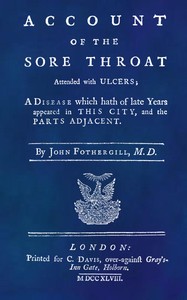
An Account of the Sore Throat Attended With Ulcers: A Disease Which Hath of Late Years Appeared in This City, and in Several Parts of the Nation
Written by John Fothergill
Chaptra reads alongside you — AI insights, chapter breakdowns and reader discussions for every book. Join free
About this book
Reading guide
Themes, characters and key ideas in An Account of the Sore Throat Attended With Ulcers: A Disease Which Hath of Late Years Appeared in This City, and in Several Parts of the Nation, written by Chaptra AI.
- about 6 hours
- advanced
- observational
- analytical
- didactic
John Fothergill's "An Account of the Sore Throat Attended With Ulcers" is an seminal 18th-century medical treatise documenting the clinical observations, progression, and recommended treatments for a severe epidemic sore throat, likely diphtheria or a virulent form of streptococcal pharyngitis, that swept through London and other parts of England. Published in 1748, it represents a pioneering effort in epidemiological reporting and clinical description, distinguishing this specific illness from other known throat ailments of the time. Fothergill meticulously details symptoms, patient responses to various remedies, and offers a comprehensive guide for medical practitioners. The work underscores the prevailing medical theories and diagnostic challenges of the era while advocating for a more empirical approach to disease management.
“A peculiar species of sore throat, attended with ulcers, has of late years appeared in this city, and in several parts of the nation.”
Key themes
- Empirical Observation and Clinical Methodology
- This theme explores Fothergill's commitment to direct observation and detailed description of symptoms, disease progression, and treatment outcomes, rather than relying solely on established theoretical frameworks. It highlights a nascent form of scientific method in medicine.
- The Nature and Spread of Contagion
- Fothergill's account grapples with the contagious nature of the disease, even without a germ theory. He observes how it spreads within families and communities, leading him to advocate for early, albeit rudimentary, public health measures.
- Medical Treatment and Intervention in the 18th Century
- The book provides a vivid snapshot of medical practices during the mid-18th century, showcasing both established (and often harmful) treatments and Fothergill's progressive, more supportive approaches. It highlights the challenges of treating severe disease with limited understanding.
Worth discussing
How did Fothergill's empirical approach challenge or align with the dominant medical theories of the 18th century (e.g., humoral pathology)?
Chapter-by-chapter breakdowns, character arcs and the full thematic analysis come with a free account.
Discussions
No one has started one yet
Questions this book opens up
No discussions yet
Be the first to start a discussion about this book!
Sign up to start the discussionReviews
No reviews yet
Be the first to review this book!