
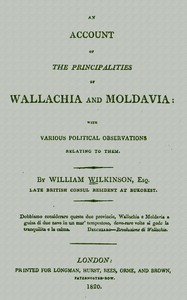
An account of the principalities of Wallachia and Moldavia: with various political observations relating to them
Written by William Wilkinson
Chaptra reads alongside you — AI insights, chapter breakdowns and reader discussions for every book. Join free
About this book
Reading guide
Themes, characters and key ideas in An account of the principalities of Wallachia and Moldavia: with various political observations relating to them, written by Chaptra AI.
- about 8 hours
- advanced
- Informative
- Historical
- Analytical
William Wilkinson's "An Account of the Principalities of Wallachia and Moldavia" is an essential early 19th-century historical and political survey of these two crucial Danubian provinces. Drawing on his unique experience as British consul in Bucharest, Wilkinson meticulously details their geographical, political, and economic landscapes, tracing their evolution from ancient Dacian roots to their contemporary status under Ottoman suzerainty. The work serves as a comprehensive analysis of the region's complex geopolitical position, caught between competing empires, while also exploring its societal structures, vibrant culture, and untapped economic potential. It stands as a vital primary source for understanding the strategic importance and internal dynamics of a region central to the broader European 'Eastern Question'.
“The Principalities of Wallachia and Moldavia present a singular phenomenon in the political geography of Europe, being at once the key to the Ottoman Empire and the theatre of contending influences.”
Key themes
- Geopolitical Significance and Conflict
- This theme explores Wallachia and Moldavia's crucial role as a strategic crossroads and a perpetual arena for the competing interests of the Ottoman, Russian, and Austrian Empires. Wilkinson emphasizes how their unique geographical position made them both a prize and a buffer state, constantly subject to external pressures and military campaigns, directly impacting their internal stability and development.
- Identity and Autonomy under Imperial Rule
- Wilkinson examines the complex identity of the Wallachians and Moldavians, who, despite centuries of foreign domination, maintained a distinct cultural and historical heritage. The theme delves into the delicate balance of their nominal autonomy under the Ottoman Porte versus the reality of external control, highlighting the aspirations for greater self-governance and the challenges of preserving a unique identity amidst diverse influences.
- Economic Potential vs. Exploitation
- This theme explores the striking contrast between the vast natural wealth and agricultural potential of Wallachia and Moldavia and the economic stagnation and exploitation they experienced. Wilkinson highlights the fertility of the land and its resources, arguing that mismanagement, corruption, and the tribute system imposed by the Ottoman Empire hindered genuine prosperity and development, leaving much of the potential untapped.
Worth discussing
How does Wilkinson's perspective as a British consul shape his analysis of Wallachia and Moldavia?
Chapter-by-chapter breakdowns, character arcs and the full thematic analysis come with a free account.
Discussions
No one has started one yet
Questions this book opens up
No discussions yet
Be the first to start a discussion about this book!
Sign up to start the discussionReviews
No reviews yet
Be the first to review this book!