
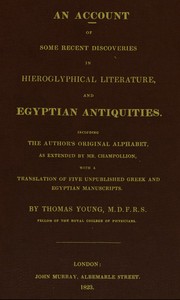
An account of some recent discoveries in hieroglyphical literature, and Egyptian antiquities : $b including the author's original alphabet, as extended by Mr. Champollion, with a translation of five unpublished Greek and Egyptian manuscripts
Written by Thomas Young
Chaptra reads alongside you — AI insights, chapter breakdowns and reader discussions for every book. Join free
About this book
Reading guide
Themes, characters and key ideas in An account of some recent discoveries in hieroglyphical literature, and Egyptian antiquities : $b including the author's original alphabet, as extended by Mr. Champollion, with a translation of five unpublished Greek and Egyptian manuscripts, written by Chaptra AI.
- about 20 hours
- advanced
- scholarly
- analytical
- pioneering
Thomas Young's "An account of some recent discoveries in hieroglyphical literature" is a seminal early 19th-century scientific publication detailing the groundbreaking efforts to decipher ancient Egyptian hieroglyphs. The work meticulously outlines Young's original research, emphasizing the pivotal role of the Rosetta Stone as the key to unlocking these enigmatic symbols. It presents his initial hieroglyphic alphabet and acknowledges its extension by Jean-François Champollion, demonstrating the collaborative yet competitive nature of early Egyptology. The book culminates in the practical application of these decipherment techniques through the translation of previously unpublished Greek and Egyptian manuscripts, solidifying its place as a cornerstone in the study of ancient Egyptian language and culture.
“The Rosetta Stone provided the invaluable key, a document of unparalleled importance, unlocking the secrets of ages.”
Key themes
- The Power of Decipherment and Unlocking History
- This theme explores the profound impact of understanding ancient languages, transforming mute symbols into a living record of a civilization. Young's work demonstrates how decipherment is not merely a linguistic exercise but a key to unlocking historical narratives, cultural practices, and the very essence of a long-lost society, thereby expanding human knowledge and challenging previous misconceptions.
- Collaboration and Intellectual Rivalry in Scientific Discovery
- The book subtly explores the dynamic between individual genius and collective effort, as well as the competitive drive that often characterizes scientific breakthroughs. While Young presents his original findings, he also acknowledges Champollion's extensions, highlighting how progress in complex fields often involves multiple contributors, sometimes in a race for recognition, yet ultimately advancing the shared goal of knowledge.
- The Scientific Method and Rigorous Inquiry
- Young's work is a masterclass in applying systematic and empirical methods to a historical and linguistic puzzle. It demonstrates the power of observation, hypothesis formation, comparative analysis, and verification through evidence. The book's structure itself reflects the scientific process, moving from problem identification to methodology, results, and validation, providing a model for rigorous scholarly investigation.
Worth discussing
Discuss the ethical implications of 'claiming' discoveries in a field where collaboration and competition are intertwined, specifically regarding Young and Champollion.
Chapter-by-chapter breakdowns, character arcs and the full thematic analysis come with a free account.
Discussions
No one has started one yet
Questions this book opens up
No discussions yet
Be the first to start a discussion about this book!
Sign up to start the discussionReviews
No reviews yet
Be the first to review this book!