
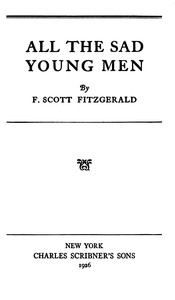
All the Sad Young Men
Written by F. Scott (Francis Scott) Fitzgerald
Chaptra reads alongside you — AI insights, chapter breakdowns and reader discussions for every book. Join free
About this book
Read it with a club
Chaptra's fiction clubs — small groups reading the same books and talking as they go.


CraxMe Readers Book Club
Fiction
- 385 members
- 227 discussions
- Started December 2025
Welcome to the Readers Book Club. This is an informal group for like-minded people, where you can discuss books, share and recommend, track your reading progress, and lots more. Discuss Books — all about books. Discuss a particular book or genre, share your favourite quotes. Book Reviews — loved a book and highly recommend it? Or was it just average? Share your review and discuss with fellow readers. (May contain spoilers.) Group Reads — what is a book club without a group read! Buddy Reads — planning to read a book and looking for someone to read it with? Post in the Buddy Read request thread, find a reading buddy, and start discussing.
Read All the Sad Young Men alongside people who are reading it too.
Also here: Doorstops, First Lines Club
Chaptra Prime — paid clubs, every club feature, and unlimited reading support, for $5 a month or $60 once.
See PrimeReading guide
Themes, characters and key ideas in All the Sad Young Men, written by Chaptra AI.
- about 8 hours
- intermediate
- melancholy
- reflective
- cynical
F. Scott Fitzgerald's "All the Sad Young Men" is a poignant collection of short stories that serves as a quintessential literary artifact of the American Jazz Age. Through intricate character studies, Fitzgerald dissects the lives of young men and women grappling with the dual pressures of immense wealth and profound existential disillusionment. The stories collectively explore the ephemeral nature of love, the corrupting influence of privilege, and the often-unfulfilled promise of the American Dream. With a melancholic tone, the collection offers a critical yet empathetic look at a generation defined by its superficial glamour and underlying despair, ultimately painting a vivid portrait of a society at a crossroads.
“Let me tell you about the very rich. They are different from you and me. They possess and enjoy early, and it does something to them, makes them soft where we are hard, and cynical where we are trustful, in a way that, unless you were born rich, it is very difficult to understand.”
Key themes
- The Disillusionment of the American Dream
- This theme is central to Fitzgerald's work, exploring how the pursuit of wealth and happiness often leads to emptiness and despair for his characters. The American Dream, particularly for the wealthy, is shown to be a superficial construct that fails to provide true fulfillment or meaning. Characters frequently achieve material success but find themselves isolated, lonely, and profoundly unhappy, questioning the value of their achievements.
- Wealth and its Corrupting Influence
- Fitzgerald meticulously examines how vast wealth can shape, and often distort, character and relationships. He argues that being born rich creates a fundamental difference in individuals, fostering a sense of entitlement, cynicism, and an inability to connect authentically with others. Wealth provides comfort but also insulates characters from the consequences of their actions, leading to moral decay and emotional stuntedness.
- Love, Loss, and Failed Relationships
- A recurring motif throughout the collection is the fragility and ultimate failure of romantic relationships, often due to character flaws, societal pressures, or the passage of time. Love is often portrayed as an idealized, fleeting state that is difficult to sustain in the face of reality, leading to profound heartbreak and regret. Characters frequently yearn for a lost love or struggle to maintain intimacy.
Worth discussing
How does Fitzgerald portray the 'sadness' of the young men and women in the collection? Is it a universal sadness or one specific to their social class?
Chapter-by-chapter breakdowns, character arcs and the full thematic analysis come with a free account.
Discussions
No one has started one yet
Questions this book opens up
No discussions yet
Be the first to start a discussion about this book!
Sign up to start the discussionReviews
No reviews yet
Be the first to review this book!