
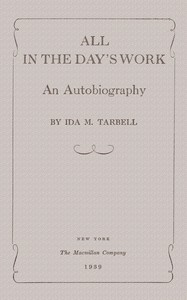
All in the Day's Work: An Autobiography
Written by Ida M. (Ida Minerva) Tarbell
Chaptra reads alongside you — AI insights, chapter breakdowns and reader discussions for every book. Join free
About this book
Reading guide
Themes, characters and key ideas in All in the Day's Work: An Autobiography, written by Chaptra AI.
- about 12 hours
- intermediate
- Historical
- Reflective
- Inspirational
Ida M. Tarbell's "All in the Day's Work" is a compelling autobiography chronicling her journey from a humble birth in a Pennsylvania log house to becoming a prominent journalist and biographer. The narrative vividly portrays her early life amidst the harsh realities of a rapidly industrializing post-Civil War America, shaped by her pioneering family's struggles and her father's resilience. Tarbell meticulously details her intellectual awakening, challenging the societal limitations placed upon women of her era and steadfastly pursuing education. Her story is one of unwavering determination, tracing her evolution from an aspiring scientist to a truth-seeking professional who profoundly influenced American society, all while navigating personal identity within a transformative community.
“From the log house, I watched the world change, and understood early that nothing truly worthwhile came without struggle.”
Key themes
- Personal Growth and Self-Discovery
- Central to any autobiography, this theme explores Tarbell's evolution from a curious child in rural Pennsylvania to an influential professional. It delves into her intellectual awakening, her process of identifying her talents and passions, and her journey to define her own path in life, often against societal expectations. Her self-discovery is inextricably linked to her professional development and her understanding of her place in the world.
- Challenging Societal Norms and Gender Roles
- This theme highlights Tarbell's active questioning and defiance of the limitations placed upon women in the late 19th and early 20th centuries. Her pursuit of higher education and a professional career, particularly in fields dominated by men (science, journalism), showcases her pioneering spirit and her determination to forge an identity beyond traditional domestic roles. The narrative explicitly addresses the dynamics of a woman seeking her identity in a rapidly changing society.
- Historical Context and Industrialization
- Tarbell's life story is deeply embedded in the historical context of late 19th and early 20th century America, particularly the impact of industrialization and economic upheaval. The autobiography uses her personal experiences, such as her family's struggles post-Panic of 1857 and her father's involvement in the oil industry, to illustrate the broader societal transformations, economic forces, and ethical challenges of the era. It provides a ground-level view of an America in transition.
Worth discussing
How does Tarbell's childhood in a pioneering family shape her later perspectives on industry and society?
Chapter-by-chapter breakdowns, character arcs and the full thematic analysis come with a free account.
Discussions
No one has started one yet
Questions this book opens up
No discussions yet
Be the first to start a discussion about this book!
Sign up to start the discussionReviews
No reviews yet
Be the first to review this book!