
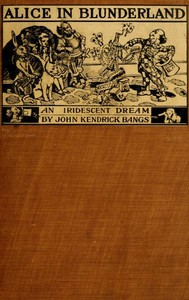
Alice in Blunderland: An Iridescent Dream
Written by John Kendrick Bangs
Chaptra reads alongside you — AI insights, chapter breakdowns and reader discussions for every book. Join free
About this book
Reading guide
Themes, characters and key ideas in Alice in Blunderland: An Iridescent Dream, written by Chaptra AI.
- about 5 hours
- intermediate
- humorous
- satirical
- whimsical
John Kendrick Bangs' "Alice in Blunderland: An Iridescent Dream" is a witty early 20th-century satirical novel that reimagines Lewis Carroll's Alice in a world governed by extreme municipal ownership. Alice finds herself in Blunderland, a city where every aspect of life, from personal hygiene to artistic expression, is rigidly controlled by the government, leading to a series of outlandish and comical situations. Through her encounters with familiar Wonderland characters now serving as bureaucrats, Alice witnesses the absurdities and oppressive nature of a system that prioritizes collective control over individual freedom. The narrative serves as a sharp critique of the progressive and socialist ideals gaining traction at the time, highlighting the potential for well-intentioned policies to devolve into stifling bureaucracy and the suppression of individuality. Ultimately, Alice's journey through Blunderland makes her yearn for the sanity and liberty of her own reality, culminating in her escape from this peculiar utopian nightmare.
““In Blunderland, you see, we have achieved perfect equality. Everyone is equally provided for, even if it means no one is particularly pleased.””
Key themes
- Critique of Municipal Ownership and Government Control
- This is the central theme of the novel. Bangs uses Blunderland as an exaggerated allegory to satirize the early 20th-century progressive and socialist movements advocating for extensive government control over public services and private lives. The book argues that while such ideals may stem from good intentions (like ensuring equality or efficiency), they can lead to absurd, oppressive, and ultimately dehumanizing outcomes when taken to extremes.
- Loss of Individuality and Personal Freedom
- A direct consequence of the extensive government control in Blunderland is the erosion of individual identity, choice, and freedom. The characters are reduced to cogs in a system, their preferences, creativity, and unique traits subsumed by state mandates. Alice's growing distress highlights the human cost of a society that prioritizes collective uniformity over personal autonomy.
- The Absurdity of Bureaucracy and Illogical Logic
- Bangs satirizes the inherent illogic that can arise when systems become overly complex and self-serving. The rules and regulations of Blunderland, while ostensibly designed for efficiency or equality, often lead to comically irrational situations. The characters' unwavering belief in these absurdities underscores how bureaucracy can warp common sense and create its own convoluted reality.
Worth discussing
How does Bangs use the framework of Lewis Carroll's Wonderland to enhance his political satire? What are the advantages of this approach?
Chapter-by-chapter breakdowns, character arcs and the full thematic analysis come with a free account.
Discussions
No one has started one yet
Questions this book opens up
No discussions yet
Be the first to start a discussion about this book!
Sign up to start the discussionReviews
No reviews yet
Be the first to review this book!