
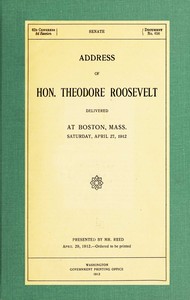
Address of Hon. Theodore Roosevelt, delivered at Boston, Mass., Saturday, April 27, 1912
Written by Theodore Roosevelt
Chaptra reads alongside you — AI insights, chapter breakdowns and reader discussions for every book. Join free
About this book
Reading guide
Themes, characters and key ideas in Address of Hon. Theodore Roosevelt, delivered at Boston, Mass., Saturday, April 27, 1912, written by Chaptra AI.
- about 1 hours
- intermediate
- Inspirational
- Rallying
- Urgent
Theodore Roosevelt's 1912 Boston address is a seminal political speech delivered during his Progressive "Bull Moose" campaign. It passionately articulates his vision for America, advocating for significant reforms in governance, corporate regulation, and civil rights. Roosevelt critiques the established political order and the judicial system for failing working-class Americans, emphasizing the necessity of prioritizing progressive principles over political personalities. He rallies support by invoking Massachusetts' historical significance and calling for revitalized citizen engagement to achieve social justice and a more equitable democracy. The speech serves as both a powerful campaign tool and a profound reflection of the era's political and social aspirations.
“We stand for the people; we stand for justice; we stand for fair play; we stand for the square deal.”
Key themes
- Progressivism & Reform
- The central theme, advocating for significant societal and governmental changes to address the challenges of industrialization, corporate power, and social inequality. Roosevelt champions an active government role in ensuring public welfare and regulating economic forces.
- Citizen Engagement & Democratic Principles
- Roosevelt emphasizes that true democracy requires active participation from its citizens, not just passive consent. He calls for reforms that would give more direct power to the people, contrasting this with the rule of political "bosses" and special interests.
- Social Justice & Fairness
- A core tenet of Roosevelt's appeal, highlighting the need for equitable treatment and protection for all, especially working-class Americans and the underprivileged. He critiques systems that perpetuate injustice and calls for a "square deal" for everyone.
Worth discussing
How does Roosevelt use the historical context of Massachusetts to strengthen his progressive arguments?
Chapter-by-chapter breakdowns, character arcs and the full thematic analysis come with a free account.
Discussions
No one has started one yet
Questions this book opens up
No discussions yet
Be the first to start a discussion about this book!
Sign up to start the discussionReviews
No reviews yet
Be the first to review this book!