
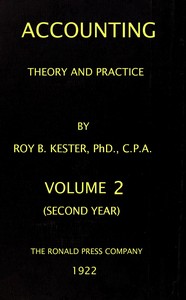
Accounting theory and practice, Volume 2 (of 3) : $b a textbook for colleges and schools of business administration
Written by Roy B. (Roy Bernard) Kester
Chaptra reads alongside you — AI insights, chapter breakdowns and reader discussions for every book. Join free
About this book
Reading guide
Themes, characters and key ideas in Accounting theory and practice, Volume 2 (of 3) : $b a textbook for colleges and schools of business administration, written by Chaptra AI.
- about 40 hours
- advanced
- Informative
- Instructive
- Analytical
Roy B. Kester's "Accounting Theory and Practice, Volume 2" is an early 20th-century collegiate textbook designed for business administration students, building upon foundational principles introduced in its predecessor. This volume specifically delves into the advanced accounting complexities of corporations, emphasizing critical principles of valuation pertinent to corporate balance sheets. Kester meticulously details corporate structure, various stock types, and essential accounting practices for effective financial management. The work advocates for a systematic approach to expense handling, underscoring the vital role of accurate accounting in business organization and management.
“The understanding of corporate financial complexities begins with a meticulous grasp of its structure and the nature of its capital.”
Key themes
- Principles of Valuation
- This is a core focus, emphasizing the methods and theories behind assigning monetary value to assets, liabilities, and equity within a corporate context. Kester stresses that accurate valuation is not merely a technical exercise but a critical component for transparent financial reporting and sound decision-making, directly impacting the integrity of the balance sheet and reflecting the true financial position of the corporation.
- Corporate Structure and Governance
- Kester meticulously dissects the corporate entity, exploring its legal framework, organizational structure, and the various forms of capital (stocks) that define its ownership and financial architecture. This theme establishes the foundational understanding necessary for all subsequent accounting practices, highlighting how the unique nature of a corporation dictates its financial management.
- Systematic Accounting and Financial Management
- Kester advocates for a disciplined, organized, and standardized approach to all accounting practices, from recording transactions to preparing financial statements. This theme underlines the necessity of robust systems for managing expenses, tracking revenues, and ensuring data integrity, framing accounting as an essential tool for efficient business organization and effective management control, rather than just a record-keeping function.
Worth discussing
How have the fundamental principles of corporate valuation evolved since Kester's time, and what remains constant?
Chapter-by-chapter breakdowns, character arcs and the full thematic analysis come with a free account.
Discussions
No one has started one yet
Questions this book opens up
No discussions yet
Be the first to start a discussion about this book!
Sign up to start the discussionReviews
No reviews yet
Be the first to review this book!