
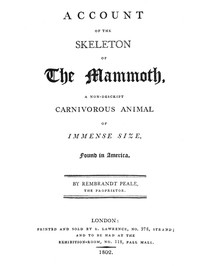
Account of the Skeleton of the Mammoth: A non-descript carnivorous animal of immense size, found in America
Written by Rembrandt Peale
Chaptra reads alongside you — AI insights, chapter breakdowns and reader discussions for every book. Join free
About this book
Reading guide
Themes, characters and key ideas in Account of the Skeleton of the Mammoth: A non-descript carnivorous animal of immense size, found in America, written by Chaptra AI.
- about 8 hours
- advanced
- Scientific
- Investigative
- Historical
Rembrandt Peale's "Account of the Skeleton of the Mammoth" is an early 19th-century scientific treatise detailing the discovery, excavation, and meticulous analysis of mammoth remains in North America. Peale systematically documents the historical context of these findings, particularly in New York and Kentucky, and describes the painstaking process of assembling the fragmented bones. Through detailed comparison with known species like elephants, he attempts to classify the mammoth, proposing it as a unique, previously unknown carnivorous entity. The work not only aims to clarify contemporary misconceptions but also significantly contributes to the nascent fields of paleontology and natural history by emphasizing empirical observation and comparative anatomy, marking a pivotal moment in understanding extinct species.
“The bones, so recently entombed, now rise to challenge our understanding of Earth's ancient inhabitants.”
Key themes
- Scientific Inquiry and Observation
- This theme explores Peale's systematic approach to understanding the unknown through empirical observation, detailed comparison, and logical deduction. It highlights the foundational principles of the scientific method as applied in early natural history, emphasizing the painstaking process of gathering evidence, formulating hypotheses, and drawing conclusions based on available data, even when that data is incomplete.
- The Nature of Extinction
- Peale's work provides compelling early evidence for the existence of species that no longer inhabit Earth. This theme delves into the evolving scientific and public understanding of extinction in the early 19th century, a concept that challenged traditional views of a static natural world and paved the way for theories of evolution and deep time, fundamentally altering humanity's perception of life on Earth.
- Challenging Preconceptions and Misconceptions
- The book actively engages with and attempts to correct prevailing scientific and popular misconceptions about the mammoth. This theme highlights the dynamic nature of scientific progress, where new evidence often necessitates the revision or outright rejection of previously held beliefs, fostering a more accurate understanding of the natural world and demonstrating the iterative process of knowledge acquisition.
Worth discussing
How did the scientific method of the early 19th century differ from modern paleontological practices, as evidenced by Peale's work?
Chapter-by-chapter breakdowns, character arcs and the full thematic analysis come with a free account.
Discussions
No one has started one yet
Questions this book opens up
No discussions yet
Be the first to start a discussion about this book!
Sign up to start the discussionReviews
No reviews yet
Be the first to review this book!