
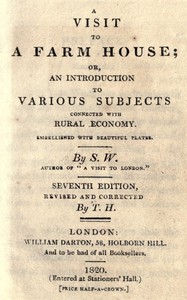
A visit to a farm house; or, An introduction to various subjects connected with rural economy.: Seventh edition, revised and corrected.
Written by active 1801-1820? S. W.
Chaptra reads alongside you — AI insights, chapter breakdowns and reader discussions for every book. Join free
About this book
Reading guide
Themes, characters and key ideas in A visit to a farm house; or, An introduction to various subjects connected with rural economy.: Seventh edition, revised and corrected., written by Chaptra AI.
- about 6 hours
- intermediate
- informative
- educational
- pastoral
"A visit to a farm house" by S. W. is an early 19th-century educational text designed to introduce readers, likely children or general audiences, to the principles and practices of rural economy. Structured as an engaging tour or series of observations within a farmhouse and its surrounding estate, the book systematically explains various subjects connected with agriculture, animal husbandry, domestic management, and the cyclical nature of farm life. It aims to impart practical knowledge and foster an appreciation for the industriousness and self-sufficiency inherent in rural living, serving as both an informative guide and a moralistic lesson on the value of labor and nature.
“"Observe, dear child, how every corner of the farm house serves a purpose, a testament to industry and thrift."”
Key themes
- Rural Economy and Self-Sufficiency
- This is the central theme, exploring the practical aspects of managing a farm, from crop cultivation and animal husbandry to domestic production (e.g., butter, cheese, textiles). The book emphasizes how a well-run farm operates as a largely self-sufficient unit, producing most of what it consumes and generating surplus for trade. It details the interconnectedness of various farm activities and the economic principles that govern them.
- Education and Didacticism
- The book itself is a testament to the theme of education, specifically the early 19th-century approach to instructing young minds in practical subjects. It demonstrates a pedagogical model where direct observation, guided inquiry, and clear explanation are used to impart knowledge. The interaction between The Guide and The Learner exemplifies the process of effective instruction and learning.
- The Value of Labor and Industry
- Throughout the text, there is an implicit and explicit celebration of hard work, diligence, and the rewards of sustained effort. The farm is presented as a place where prosperity is directly linked to the labor invested by its inhabitants. This theme underscores a core Protestant work ethic prevalent in the era, where idleness is discouraged and productivity is lauded.
Worth discussing
How does S. W.'s depiction of rural economy compare to modern agricultural practices and challenges?
Chapter-by-chapter breakdowns, character arcs and the full thematic analysis come with a free account.
Discussions
No one has started one yet
Questions this book opens up
No discussions yet
Be the first to start a discussion about this book!
Sign up to start the discussionReviews
No reviews yet
Be the first to review this book!