
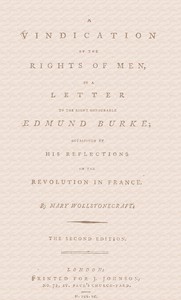
A vindication of the rights of men, in a letter to the Right Honourable Edmund Burke; occasioned by his Reflections on the Revolution in France
Written by Mary Wollstonecraft
Chaptra reads alongside you — AI insights, chapter breakdowns and reader discussions for every book. Join free
About this book
Reading guide
Themes, characters and key ideas in A vindication of the rights of men, in a letter to the Right Honourable Edmund Burke; occasioned by his Reflections on the Revolution in France, written by Chaptra AI.
- about 10 hours
- advanced
- Argumentative
- Passionate
- Incisive
Mary Wollstonecraft's "A Vindication of the Rights of Men" is a powerful and direct philosophical counter-argument to Edmund Burke's "Reflections on the Revolution in France." Published in 1790, it passionately defends the principles of natural rights, reason, and individual liberty against Burke's reverence for tradition, inherited privilege, and emotional appeals. Wollstonecraft critiques Burke's perceived sophistry and calls for a deeper moral and political reform founded on universal human rights rather than antiquated customs or social hierarchies. The work champions the Enlightenment ideals of progress and the inherent dignity of all individuals, positioning itself as a crucial early text in the discourse surrounding the French Revolution and broader human rights.
“The birthright of man, to give your favorite epithet a more precise meaning, is such a degree of liberty, civil and religious, as is compatible with the liberty of every other individual with whom he is united in a social compact.”
Key themes
- Reason vs. Tradition
- This is the central philosophical conflict of the work. Wollstonecraft champions reason as the primary faculty for moral and political judgment, arguing that it should guide human affairs and serve as the foundation for rights and justice. She directly opposes Burke's reverence for tradition, inherited customs, and unthinking deference to the past, viewing them as sources of prejudice and oppression.
- Natural Rights and Universal Equality
- Wollstonecraft articulates a robust defense of natural rights, arguing that all individuals are born with inherent rights simply by virtue of being human, endowed by a benevolent God. These rights, she contends, are universal and not dependent on social class, gender, or inherited status. This theme forms the bedrock of her critique against Burke's defense of a hierarchical society based on birthright.
- Critique of Social Hierarchy and Aristocracy
- Wollstonecraft launches a scathing attack on the aristocracy and inherited privilege, arguing that such systems are inherently corrupting, both for those who possess power and for society as a whole. She contends that inherited wealth and titles lead to idleness, moral decay, and a lack of genuine merit, ultimately undermining the common good and perpetuating injustice.
Worth discussing
How does Wollstonecraft's concept of 'reason' contrast with Burke's reverence for 'tradition' and 'sentiment'?
Chapter-by-chapter breakdowns, character arcs and the full thematic analysis come with a free account.
Discussions
No one has started one yet
Questions this book opens up
No discussions yet
Be the first to start a discussion about this book!
Sign up to start the discussionReviews
No reviews yet
Be the first to review this book!