
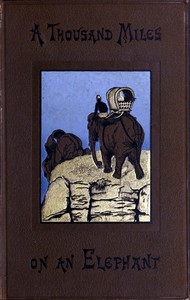
A thousand miles on an elephant in the Shan States
Written by Holt S. (Holt Samuel) Hallett
Chaptra reads alongside you — AI insights, chapter breakdowns and reader discussions for every book. Join free
About this book
Reading guide
Themes, characters and key ideas in A thousand miles on an elephant in the Shan States, written by Chaptra AI.
- about 12 hours
- advanced
- exploratory
- informative
- adventurous
Holt S. Hallett's "A Thousand Miles on an Elephant in the Shan States" is a late 19th-century travel narrative chronicling the author's extensive expedition through the Shan States and adjacent regions of Southeast Asia. Driven by the strategic imperative to survey a viable railway route connecting British Burma with southwestern China, the book details the logistical challenges, geographical observations, and cultural encounters inherent in such an ambitious undertaking. Hallett, accompanied by Dr. Cushing, embarks from Shoaygoon, navigating treacherous landscapes and managing a diverse retinue of local staff and elephants. Beyond its primary focus on infrastructure, the narrative offers a significant window into the ethnography, political landscape, and colonial ambitions of the era, presenting a blend of adventure, scientific observation, and imperial rationale.
“"Our mission, though arduous, was clear: to forge a path for commerce where only jungle paths now wound, connecting the heart of British Burma to the vast markets of China."”
Key themes
- Colonialism and Imperialism
- The core theme, as the entire expedition is driven by the British Empire's desire to expand its commercial and strategic influence into Southeast Asia and China. The railway is presented as a tool for imperial control and economic exploitation.
- Exploration and Discovery
- Beyond the political agenda, the book celebrates the spirit of adventure, the charting of unknown territories, and the scientific curiosity to document new landscapes, peoples, and natural phenomena. It's a testament to human endeavor in the face of the unknown.
- Cultural Encounter and Ethnography
- The narrative extensively details encounters with various indigenous groups within the Shan States. Hallett provides observations on their customs, social structures, languages, and daily lives, offering a snapshot of diverse cultures through a Victorian lens.
Worth discussing
How does Hallett's narrative reflect the prevailing attitudes of British imperialism and colonialism in the late 19th century?
Chapter-by-chapter breakdowns, character arcs and the full thematic analysis come with a free account.
Discussions
No one has started one yet
Questions this book opens up
No discussions yet
Be the first to start a discussion about this book!
Sign up to start the discussionReviews
No reviews yet
Be the first to review this book!