
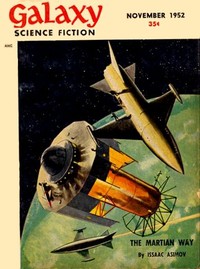
A Thought For Tomorrow
Written by Robert E. Gilbert
Chaptra reads alongside you — AI insights, chapter breakdowns and reader discussions for every book. Join free
About this book
Reading guide
Themes, characters and key ideas in A Thought For Tomorrow, written by Chaptra AI.
- about 1 hours
- intermediate
- surreal
- philosophical
- disorienting
Robert E. Gilbert's "A Thought For Tomorrow" is an early 1950s science fiction short story that blurs the lines between perception and reality through the eyes of its protagonist, Orville Potts. Confined to a psychiatric hospital, Orville experiences vivid delusions of time travel, believing his mind can transcend physical limitations. The narrative follows his surreal attempts to alter historical events and escape his oppressive environment, marked by abusive attendants and his own fractured sense of self. Ultimately, Orville's conviction culminates in a fantastical escape aboard a future spaceship, prompting a profound exploration of mental power, existence, and the nature of perceived reality.
“"They say I'm mad, but what if their 'reality' is merely a smaller cage?"”
Key themes
- Perception vs. Reality
- The central theme explores the subjective nature of reality. Orville's 'delusions' of time travel challenge the objective reality imposed by his hospital environment, prompting the reader to question which reality holds more truth or power. The story suggests that what one perceives can be as real, if not more potent, than external circumstances.
- The Power of the Mind
- This theme delves into the extraordinary capabilities of human consciousness, suggesting that the mind might possess powers beyond conventional scientific understanding. Orville's belief in his ability to time travel is portrayed as a testament to the mind's potential to transcend physical limitations, even to the point of altering or creating reality.
- Escape and Confinement
- The story powerfully explores the human desire for freedom in the face of physical and psychological confinement. Orville's literal imprisonment in the psychiatric hospital is mirrored by his internal struggle against the limitations imposed by his mental state and the external world. His time-traveling fantasies are a direct manifestation of his need to break free.
Worth discussing
How does the story challenge our understanding of reality and sanity?
Chapter-by-chapter breakdowns, character arcs and the full thematic analysis come with a free account.
Discussions
No one has started one yet
Questions this book opens up
No discussions yet
Be the first to start a discussion about this book!
Sign up to start the discussionReviews
No reviews yet
Be the first to review this book!