
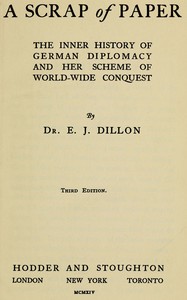
A scrap of paper : $b The inner history of German diplomacy and her scheme of world-wide conquest
Written by Emile Joseph Dillon
Chaptra reads alongside you — AI insights, chapter breakdowns and reader discussions for every book. Join free
About this book
Reading guide
Themes, characters and key ideas in A scrap of paper : $b The inner history of German diplomacy and her scheme of world-wide conquest, written by Chaptra AI.
- about 10 hours
- advanced
- Serious
- Critical
- Urgent
Dr. E. J. Dillon's "A Scrap of Paper" is a scathing early 20th-century critique of German diplomacy and expansionist ambitions, particularly in the lead-up to World War I. The book dissects Germany's strategic devaluation of international treaties, epitomized by the Chancellor's dismissive reference to the Belgian neutrality agreement as a 'scrap of paper.' Dillon argues that Germany's actions were driven by a premeditated scheme for world-wide conquest, fueled by militarism and a desire for cultural hegemony. He aims to expose the dangers of German aggression and the perilous naiveté of other European powers, particularly Britain, in underestimating these intentions, ultimately portraying the conflict as an inevitable outcome of Germany's calculated policies.
“"A scrap of paper!" Those words, flung with contempt, tore asunder the very fabric of international trust and laid bare the soul of a nation's diplomacy.”
Key themes
- The Devaluation of International Law and Treaties
- This is the central theme, epitomized by the 'scrap of paper' remark. Dillon argues that Germany systematically undermined the sanctity of treaties, viewing them as mere instruments of convenience rather than binding commitments, thereby eroding the foundations of international trust and order.
- Militarism and Aggression as State Policy
- Dillon asserts that German foreign policy was fundamentally driven by a militaristic mindset, where force and coercion were preferred over diplomacy. He portrays Germany as a nation actively pursuing expansion and dominance through military might, rather than through peaceful negotiation.
- National Ambition and Cultural Hegemony
- The book explores Germany's ambition not just for territorial expansion, but also for cultural dominance ('Kultur'). Dillon argues that Germany sought to impose its values and way of life on other nations, believing in the inherent superiority of its own culture and its right to propagate it through conquest.
Worth discussing
How does Dillon's interpretation of the 'scrap of paper' incident shape his entire argument about German diplomacy?
Chapter-by-chapter breakdowns, character arcs and the full thematic analysis come with a free account.
Discussions
No one has started one yet
Questions this book opens up
No discussions yet
Be the first to start a discussion about this book!
Sign up to start the discussionReviews
No reviews yet
Be the first to review this book!