
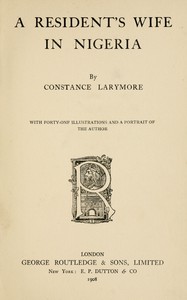
A Resident's wife in Nigeria
Written by Constance Belcher Larymore
Chaptra reads alongside you — AI insights, chapter breakdowns and reader discussions for every book. Join free
About this book
Reading guide
Themes, characters and key ideas in A Resident's wife in Nigeria, written by Chaptra AI.
- about 9 hours
- intermediate
- Observational
- Historical
- Adventurous
Constance Larymore's "A Resident's Wife in Nigeria" is an early 20th-century travel memoir offering a personal account of her experiences and observations in colonial Nigeria. The book details her daily life as the wife of a British governmental officer, chronicling the challenges and beauties of an unfamiliar landscape and culture. Beginning with her departure from Sierra Leone in 1902 and arrival in Lokoja, Larymore provides intimate glimpses into the lives of English settlers and their interactions with local Nigerian communities. Her narrative blends adventure with reflection, showcasing her resilience and curiosity while bridging the gap between her European background and the vibrant, complex world she encountered.
“The unknown stretched before us, a tapestry woven with threads of apprehension and boundless hope.”
Key themes
- Cultural Observation and Encounter
- Larymore's memoir is rich with detailed accounts of Nigerian customs, traditions, social structures, and daily life. She serves as a diligent observer, attempting to understand and document the cultures she encounters, offering a valuable (though filtered) record of indigenous societies at the turn of the 20th century.
- Colonialism and Empire
- The book explores the daily realities of British colonial presence in Nigeria through the personal lens of a colonial administrator's wife. While not overtly political, it implicitly details the structures, challenges, and human experiences within the British Empire, showcasing the 'civilizing mission' and the establishment of European administrative life.
- Adaptation and Resilience
- A central theme is Larymore's personal journey of adapting to a vastly different climate, environment, and social context. The memoir highlights her strength and fortitude in overcoming numerous challenges inherent to living in a remote colonial outpost, including difficult travel, tropical diseases, and cultural isolation.
Worth discussing
How does Larymore's perspective as a 'resident's wife' shape her observations of Nigeria and its inhabitants?
Chapter-by-chapter breakdowns, character arcs and the full thematic analysis come with a free account.
Discussions
No one has started one yet
Questions this book opens up
No discussions yet
Be the first to start a discussion about this book!
Sign up to start the discussionReviews
No reviews yet
Be the first to review this book!