
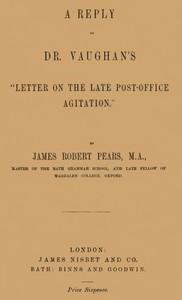
A Reply to Dr. Vaughan's "Letter on the Late Post-Office Agitation"
Written by James Roberts Pears
Chaptra reads alongside you — AI insights, chapter breakdowns and reader discussions for every book. Join free
About this book
Reading guide
Themes, characters and key ideas in A Reply to Dr. Vaughan's "Letter on the Late Post-Office Agitation", written by Chaptra AI.
- about 4 hours
- advanced
- serious
- didactic
- polemical
James Roberts Pears's "A Reply to Dr. Vaughan's 'Letter on the Late Post-Office Agitation'" is a mid-19th-century theological treatise vigorously defending the sanctity of the Sabbath against the continuation of Sunday postal services. Pears critically engages with Dr. Vaughan's arguments, which supported the services, by asserting that such practices compromise divine commandments and the spiritual well-being of society. The work is a principled stand against a utilitarian approach to morality, emphasizing that obedience to God must take precedence over convenience or material gain. It reflects the significant Victorian debates concerning the intersection of religious observance, state policy, and the encroaching secularization of public life.
“Any perceived benefits of labor on Sunday do not justify compromising divine commandments.”
Key themes
- Sabbath Observance vs. Secular Utility
- This is the central theme, exploring the conflict between the religious imperative to observe the Lord's Day as a sacred institution and the societal demands for efficiency and convenience (e.g., Sunday postal services). Pears argues vehemently that secular utility cannot justify the violation of a divine commandment.
- Divine Command vs. Human Convenience
- This theme delves into the philosophical question of whether moral obligations are derived from divine decrees or from human-centric considerations like comfort, ease, or material gain. Pears champions divine command theory, asserting that God's laws are absolute and supersede human desires for convenience.
- Moral Absolutism vs. Utilitarianism
- Pears's treatise is a direct confrontation between moral absolutism (where certain actions are inherently right or wrong, regardless of consequences) and utilitarianism (where the morality of an action is determined by its greatest good for the greatest number). Pears strongly advocates for absolutism, rejecting the utilitarian calculus that might justify Sunday labor for societal benefit.
Worth discussing
How does Pears's argument against Sunday postal services reflect broader 19th-century anxieties about secularism and industrialization?
Chapter-by-chapter breakdowns, character arcs and the full thematic analysis come with a free account.
Discussions
No one has started one yet
Questions this book opens up
No discussions yet
Be the first to start a discussion about this book!
Sign up to start the discussionReviews
No reviews yet
Be the first to review this book!