
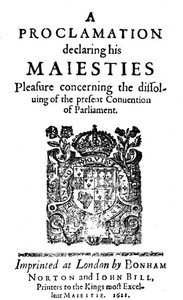
A Proclamation Declaring His Maiesties Pleasure Concerning the Dissoluing of the Present Conuention of Parliament
Written by King of England James I
Chaptra reads alongside you — AI insights, chapter breakdowns and reader discussions for every book. Join free
About this book
Reading guide
Themes, characters and key ideas in A Proclamation Declaring His Maiesties Pleasure Concerning the Dissoluing of the Present Conuention of Parliament, written by Chaptra AI.
- about 8 hours
- advanced
- authoritative
- tense
- formal
This authoritative proclamation from King James I outlines his decision to dissolve the current Parliament, offering a direct insight into early 17th-century English governance. The document articulates the monarch's perspective on the political tensions, citing initial goodwill that deteriorated into misunderstandings and conflicts with the legislative body. Emphasizing the royal prerogative, James I justifies his actions by appealing to historical practices and his commitment to justice and the welfare of his subjects. Ultimately, it serves as a critical historical record, revealing the delicate balance of power between the Crown and Parliament and the King's determination to maintain control amidst political dissension.
“"We, in Our Princely care for the Weal of Our People, did Summon this Parliament..."”
Key themes
- Royal Prerogative vs. Parliamentary Authority
- This is the core conflict of the proclamation. James I explicitly asserts the divine right and inherent power of the monarch to govern, dissolve Parliament, and make decisions for the kingdom. He sees Parliament's actions as infringing upon this prerogative, highlighting the fundamental constitutional struggle of the era regarding where ultimate sovereignty resided.
- Legitimacy of Governance and Justice
- James I frames his decision as one made out of necessity for the good governance and justice of his realm. He argues that Parliament's inefficiencies prevented him from fulfilling his royal duty to ensure the welfare of his subjects, thereby legitimizing his unilateral action as a means to restore effective rule and justice.
- Political Dissension and Unity
- The proclamation explicitly details the King's frustrations with the 'misunderstandings and conflicts' within Parliament, highlighting the challenges of maintaining political unity during a period of evolving constitutional ideas. It underscores the difficulty of achieving consensus when fundamental power structures are being contested.
Worth discussing
How does James I justify his decision to dissolve Parliament, and what does this reveal about his political philosophy?
Chapter-by-chapter breakdowns, character arcs and the full thematic analysis come with a free account.
Discussions
No one has started one yet
Questions this book opens up
No discussions yet
Be the first to start a discussion about this book!
Sign up to start the discussionReviews
No reviews yet
Be the first to review this book!