
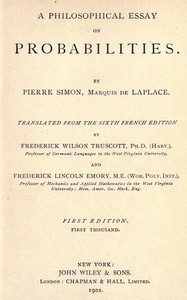
A Philosophical Essay on Probabilities
Written by Pierre Simon Laplace
Chaptra reads alongside you — AI insights, chapter breakdowns and reader discussions for every book. Join free
About this book
Reading guide
Themes, characters and key ideas in A Philosophical Essay on Probabilities, written by Chaptra AI.
- about 10 hours
- advanced
- analytical
- philosophical
- didactic
Pierre Simon Laplace's "A Philosophical Essay on Probabilities" is a seminal early 19th-century work that systematically establishes the foundational principles of probability theory. Laplace argues that probability is not merely a mathematical tool but a fundamental aspect of human knowledge, essential for understanding uncertainty in everyday life, science, and decision-making. The essay progresses from defining core concepts and principles to illustrating their vast applications across diverse fields, from games of chance and judicial decisions to natural philosophy and moral sciences. Ultimately, it frames probability as a measure of our ignorance rather than inherent randomness, inviting readers to grasp its profound role in navigating an inherently uncertain world and in the pursuit of scientific understanding.
“The most important questions of life are, for the most part, only problems of probability.”
Key themes
- The Nature of Probability and Chance
- This theme explores Laplace's fundamental definition of probability as a measure of our ignorance, rather than an intrinsic randomness in the universe. He argues that probability quantifies the degree of certainty we have about an event based on our limited knowledge, and that a perfectly informed intelligence would perceive no chance. This theme underpins the entire essay, establishing the philosophical basis for its mathematical framework.
- Human Knowledge and Determinism
- Laplace's essay is deeply rooted in a deterministic worldview, where every event is a consequence of prior causes. Probability, therefore, arises from our incomplete knowledge of these causes and effects. This theme explores the limits of human understanding and the power of reason to approximate certainty in an inherently complex world, even if true randomness doesn't exist at a fundamental level.
- Rational Decision-Making and Expectation
- Laplace demonstrates how probability provides a rational framework for making decisions under uncertainty, both for individuals and for society. He introduces the concept of 'moral expectation' (expected utility) to guide choices where outcomes have varying values or consequences. This theme highlights the practical utility of probability in navigating life's challenges, from financial investments to judicial rulings, and even in understanding human 'hope.'
Worth discussing
How does Laplace's definition of probability (as a measure of our ignorance) compare to modern frequentist or Bayesian interpretations?
Chapter-by-chapter breakdowns, character arcs and the full thematic analysis come with a free account.
Discussions
No one has started one yet
Questions this book opens up
No discussions yet
Be the first to start a discussion about this book!
Sign up to start the discussionReviews
No reviews yet
Be the first to review this book!