
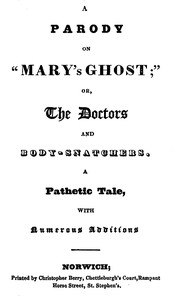
A Parody on "Mary's Ghost;" or, The Doctors and Body-snatchers.: A Pathetic Tale, With Numerous Additions.
Written by Thomas Hood
Chaptra reads alongside you — AI insights, chapter breakdowns and reader discussions for every book. Join free
About this book
Reading guide
Themes, characters and key ideas in A Parody on "Mary's Ghost;" or, The Doctors and Body-snatchers.: A Pathetic Tale, With Numerous Additions., written by Chaptra AI.
- about 1 hours
- intermediate
- humorous
- macabre
- satirical
Thomas Hood's "A Parody on 'Mary's Ghost;' or, The Doctors and Body-snatchers" is a darkly humorous poem from the early 19th century that masterfully satirizes the prevalent issue of body-snatching for medical dissection. Through the ghost of Mary, who visits her lover William, the poem comically yet poignantly laments the indignity of her dismembered body being distributed among various medical professionals. It cleverly uses the conventions of a ghostly ballad to critique the ethics of medical progress and the societal anxieties surrounding death and the treatment of the deceased. The work serves as a witty commentary on both the macabre trade and the enduring nature of love, even in the face of grotesque exploitation.
“They tore me limb from limb, dear love,”
Key themes
- Medical Ethics and Scientific Progress
- This is the central theme, directly critiquing the 19th-century practice of body-snatching to supply cadavers for medical dissection. Hood uses satire to expose the unethical means by which scientific knowledge was advanced, questioning the moral cost of progress and the dehumanization of the deceased.
- Mortality and the Afterlife
- The poem explores the fragility of human existence and the concept of an undisturbed afterlife. Mary's disturbed rest highlights the indignity inflicted upon the dead, challenging traditional notions of peace beyond the grave. It questions what truly constitutes a respectful end.
- Satire and Social Commentary
- Hood masterfully employs satire to critique a pressing social issue of his time. By using humor and exaggeration, he highlights the absurdity and horror of body-snatching, making his commentary more palatable and memorable than a purely serious denunciation would have been. The poem serves as a direct social critique of both the illicit trade and the societal conditions that fueled it.
Worth discussing
How does Hood use humor and parody to address such a grim subject as body-snatching?
Chapter-by-chapter breakdowns, character arcs and the full thematic analysis come with a free account.
Discussions
No one has started one yet
Questions this book opens up
No discussions yet
Be the first to start a discussion about this book!
Sign up to start the discussionReviews
No reviews yet
Be the first to review this book!