
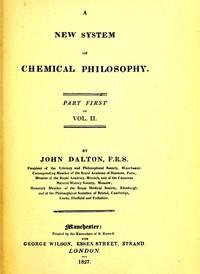
A new system of chemical philosophy, Volume 2, Part 1
Written by John Dalton
Chaptra reads alongside you — AI insights, chapter breakdowns and reader discussions for every book. Join free
About this book
Reading guide
Themes, characters and key ideas in A new system of chemical philosophy, Volume 2, Part 1, written by Chaptra AI.
- about 15 hours
- advanced
- Analytical
- Empirical
- Foundational
John Dalton's "A New System of Chemical Philosophy, Volume 2, Part 1" is a seminal scientific treatise from the early 19th century that significantly advanced the field of chemistry. This volume, published between 1817 and 1827, delves into the nature of chemical compounds, particularly metallic oxides, and the precise relationship between metals and oxygen. Dalton meticulously details his experimental methods for determining the proportions of elements within these compounds, embodying the foundational principles of atomic theory. The work highlights the challenges inherent in early chemical analysis, underscoring a dedication to empirical observation and systematic investigation that shaped modern chemistry.
“"The long interval which has elapsed since the first part of this work was published, may seem to require some apology."”
Key themes
- Empirical Observation and Experimentation
- Central to Dalton's approach, this theme highlights the necessity of meticulous experimental work and direct observation to validate scientific hypotheses. The volume is replete with detailed accounts of experiments, underscoring the belief that knowledge in chemistry must be built upon verifiable data.
- Development of Atomic Theory
- This volume serves as a critical exposition of Dalton's atomic theory, providing empirical support for his postulates regarding the indivisibility of atoms, the fixed weights of elements, and their combination in definite and multiple proportions. It moves atomic theory from a philosophical concept to a quantitatively verifiable scientific model.
- Precision and Quantitative Analysis
- Dalton's work underscores the paramount importance of accurate measurement and quantitative analysis in chemistry. He acknowledges the inherent difficulties of achieving precision with early 19th-century tools but stresses its critical role in establishing reliable chemical principles and validating theoretical models.
Worth discussing
How did Dalton's meticulous empirical approach in this volume contribute to the acceptance and refinement of atomic theory?
Chapter-by-chapter breakdowns, character arcs and the full thematic analysis come with a free account.
Discussions
No one has started one yet
Questions this book opens up
No discussions yet
Be the first to start a discussion about this book!
Sign up to start the discussionReviews
No reviews yet
Be the first to review this book!